Topkapi Palace
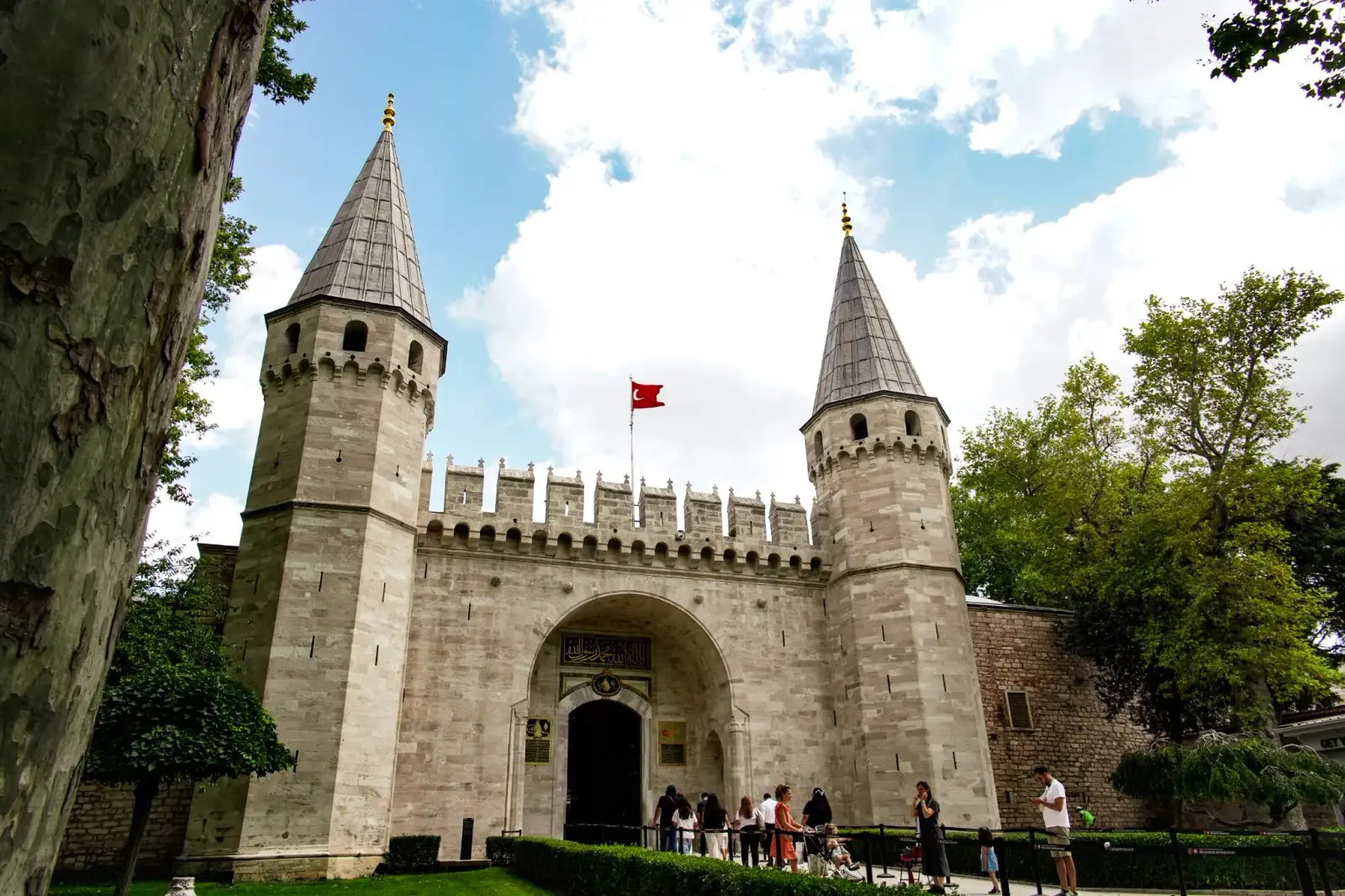
The Gate of Salutation, its two conical towers and crenellated wall under a summer sky.

The Ottoman Imperial Palace

Explore Topkapi Palace

For almost four centuries, Topkapi Palace stood at the centre of Ottoman rule. Discover its imperial courtyards, private apartments, ceremonial chambers and pavilions overlooking Istanbul.

A Palace Shaped by Centuries

Topkapi Palace was built between 1460 and 1478 by order of Sultan Mehmed II, following the Ottoman conquest of Constantinople. Rising on the historic peninsula between the Bosphorus, the Golden Horn and the Sea of Marmara, its position offered both natural protection and commanding views across the new imperial capital.

Originally known as the New Imperial Palace — Saray-ı Cedîd-i Âmire — the complex developed far beyond its earliest form. Successive sultans added new chambers, courtyards, gardens, kitchens, residences and ceremonial buildings, adapting the palace to the changing needs of the Ottoman court.

Topkapi was not simply a royal residence. It was a centre of government, education, diplomacy, ceremony, artistic production and daily palace life. Decisions affecting territories across three continents were discussed within its walls, while generations of palace officials, administrators, craftsmen and scholars were trained here.

During the middle of the 19th century, the imperial household gradually moved to newer palaces along the Bosphorus, particularly Dolmabahçe Palace. Topkapi nevertheless retained its symbolic importance, continuing to house the Imperial Treasury, the Holy Relics and the palace archives.

The palace became a museum on 3 April 1924. Today, excluding Gülhane Park, the complex covers approximately 350,000 square metres and remains one of the world’s most extensive surviving palace museums.

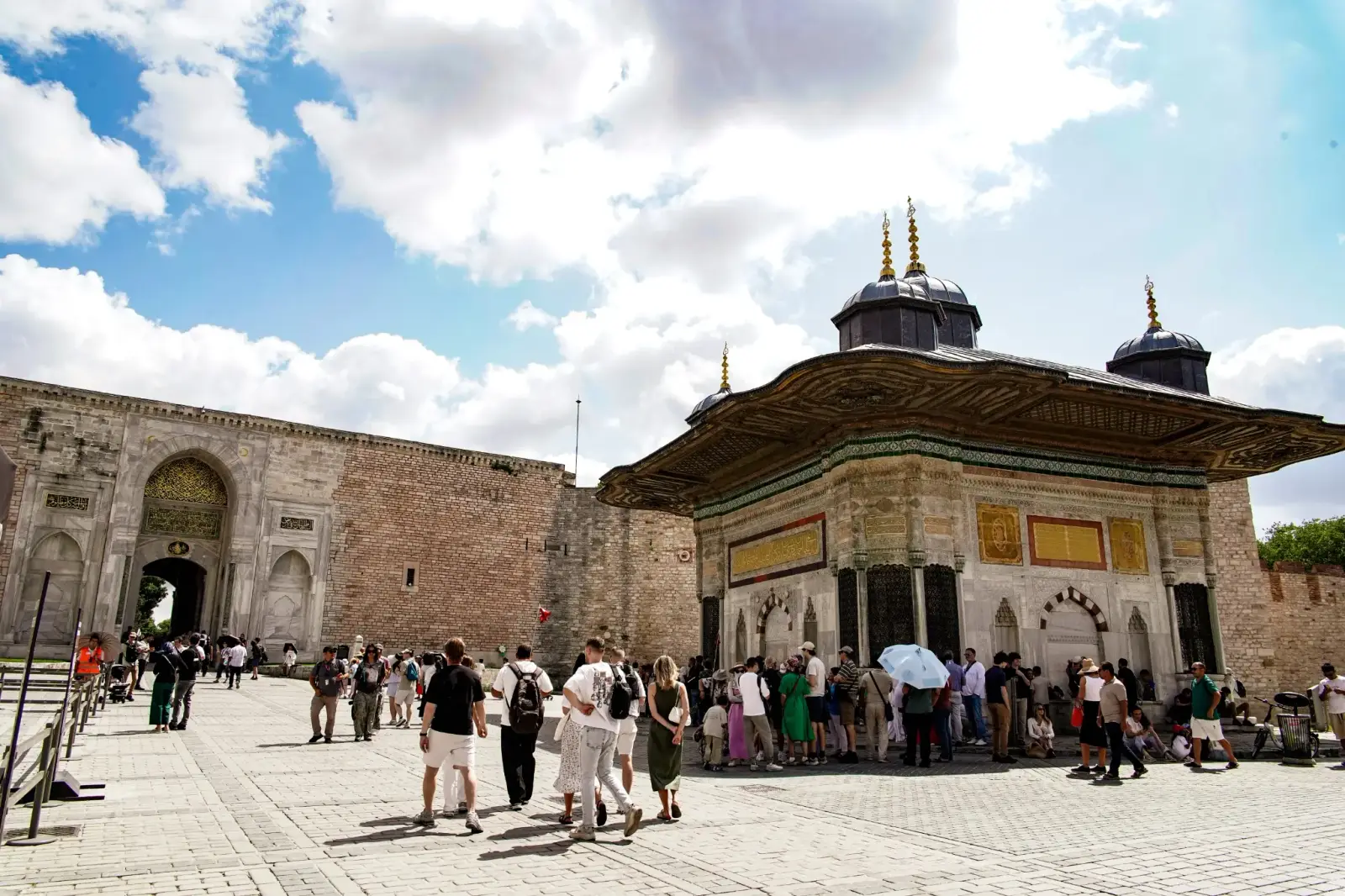
The Fountain of Ahmed III outside the Imperial Gate, its carved marble panels under wide eaves.

The Four Courtyards

From the Imperial Gate to the Sultan’s Private Gardens

Topkapi Palace is organised around four principal courtyards. As visitors move deeper into the complex, each successive courtyard becomes more restricted, ceremonial and private.

This carefully ordered layout reflected the hierarchy of the Ottoman court: from the service areas of the outer palace to the administrative centre, the Inner Palace and finally the private gardens of the sultan.

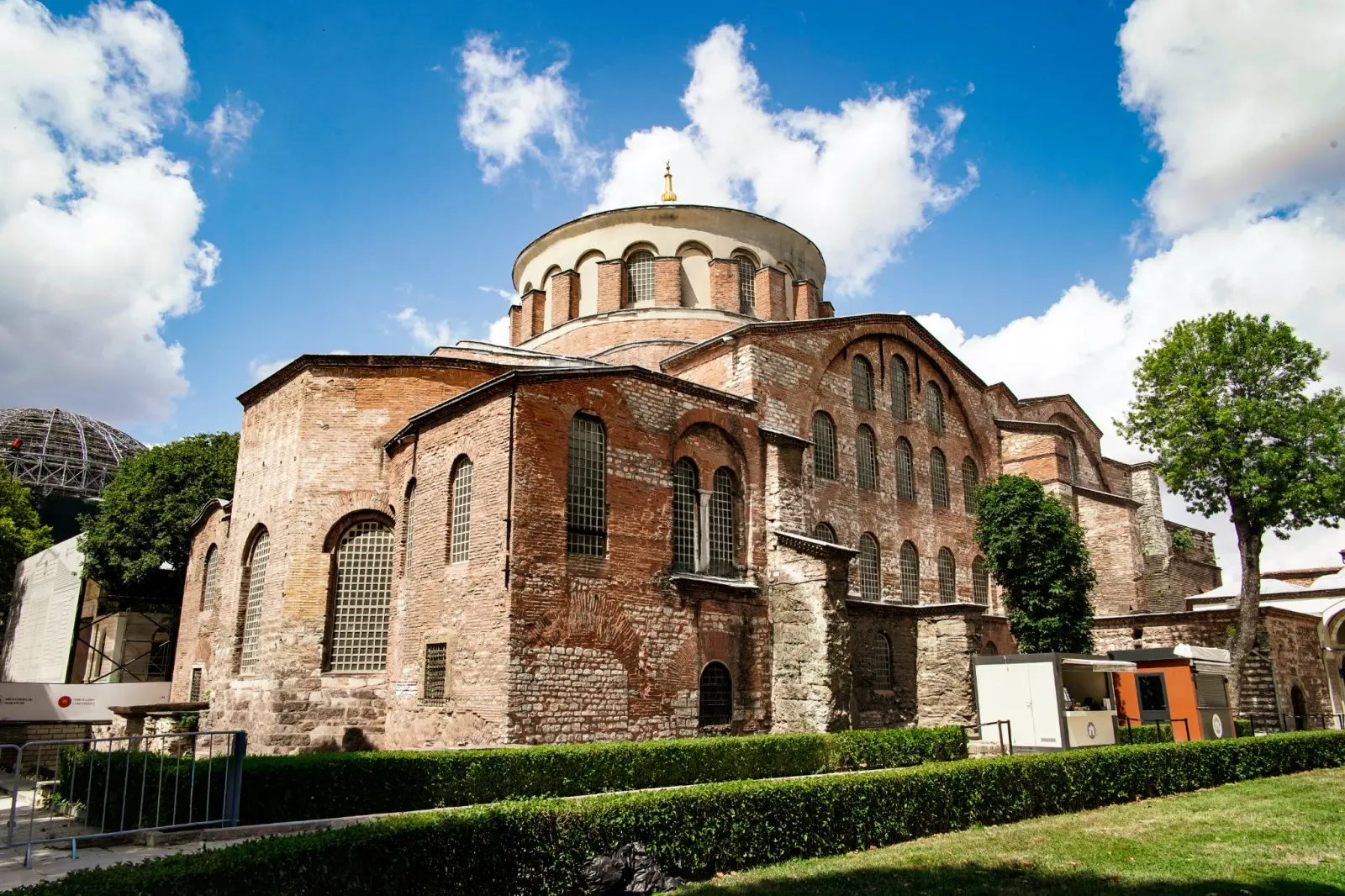
The full elevation of Hagia Irene, the oldest surviving church in Istanbul, inside the palace grounds.
01

First Courtyard

The Outer Palace

Entered through the Imperial Gate, the First Courtyard was the most publicly accessible area of the palace. Officials, palace workers, soldiers, messengers and visitors passed through this spacious outer court.

It contained administrative and service buildings as well as Hagia Irene, one of the oldest surviving monuments within the palace grounds.

Highlights

  • Imperial Gate
  • Hagia Irene
  • Imperial Mint
  • Outer palace gardens
  • Former service buildings
First Courtyard
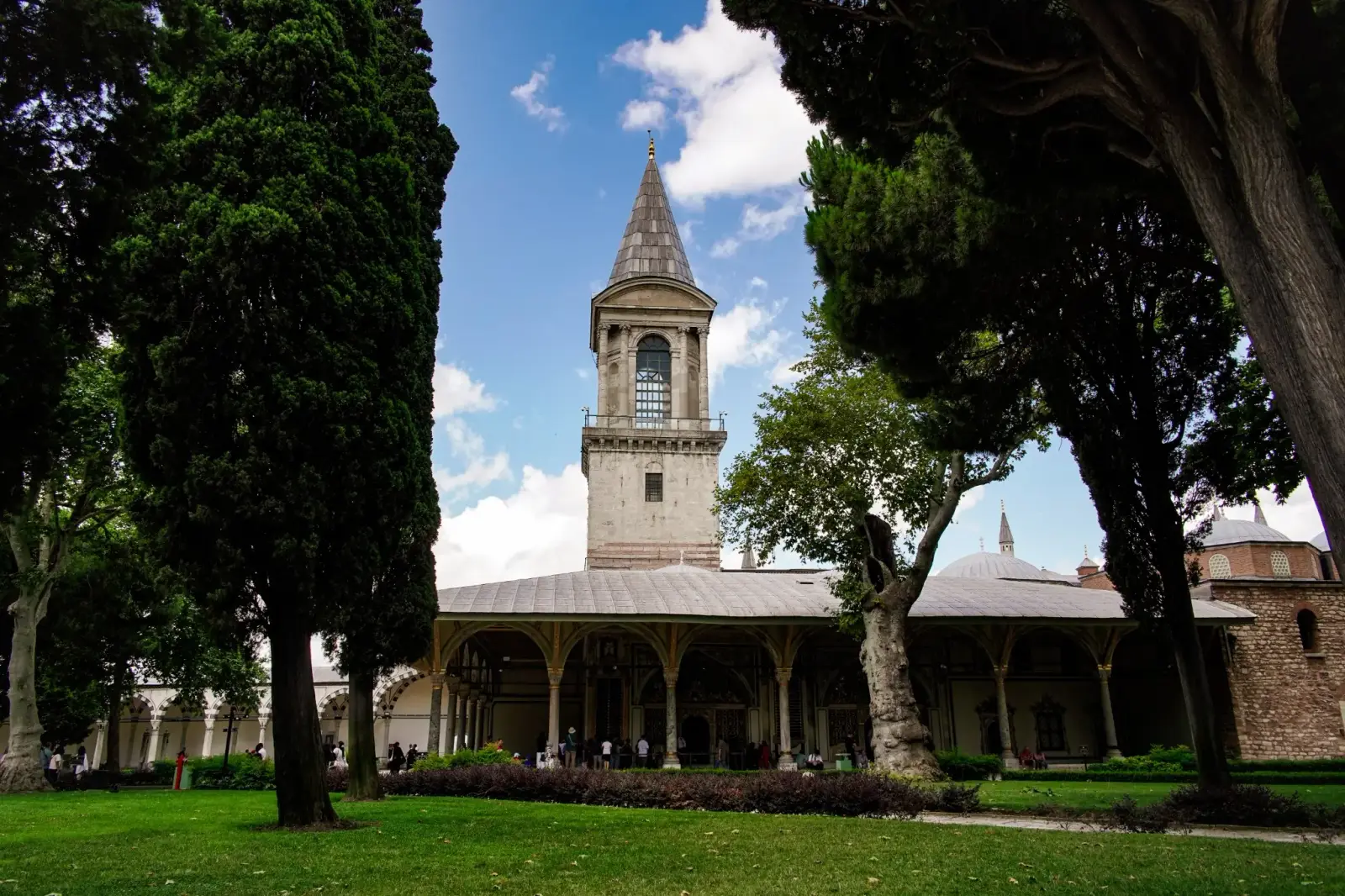
The Tower of Justice rising above the Second Courtyard, seen between cypresses and plane trees.
02

Second Courtyard

The Administrative Heart

Beyond the Gate of Salutation lies the Second Courtyard, once the administrative and ceremonial centre of the Ottoman court.

The Imperial Council met here to discuss affairs of state, while the extensive Palace Kitchens prepared food for the imperial household and palace staff. The entrances to the Imperial Harem and the former Imperial Stables are also located around this courtyard.

Highlights

  • Gate of Salutation
  • Imperial Council
  • Tower of Justice
  • Palace Kitchens
  • Imperial Stables
  • Harem entrance
Second Courtyard
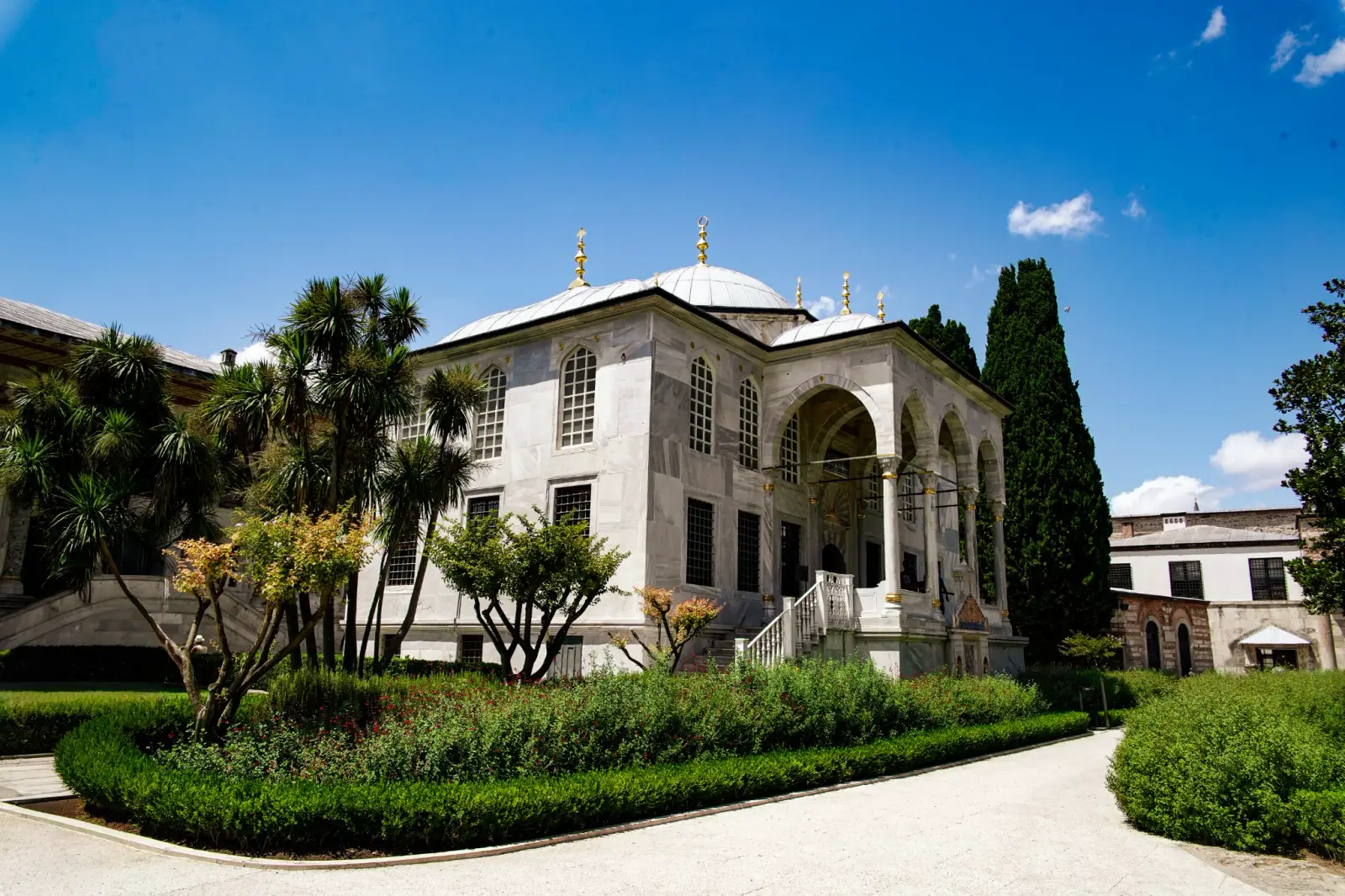
The Library of Ahmed III at the centre of the Third Courtyard, clad in white marble.
03

Third Courtyard

The Inner Palace

The Gate of Felicity marks the entrance to the Third Courtyard, historically known as the Inner Palace. Access to this area was closely controlled, and entry took place according to strict court protocol.

The courtyard contained the Audience Chamber, where the sultan received senior officials and foreign ambassadors, as well as the Enderun Palace School, Imperial Treasury and Privy Chamber.

Highlights

  • Gate of Felicity
  • Audience Chamber
  • Enderun Library
  • Imperial Treasury
  • Privy Chamber
Third Courtyard
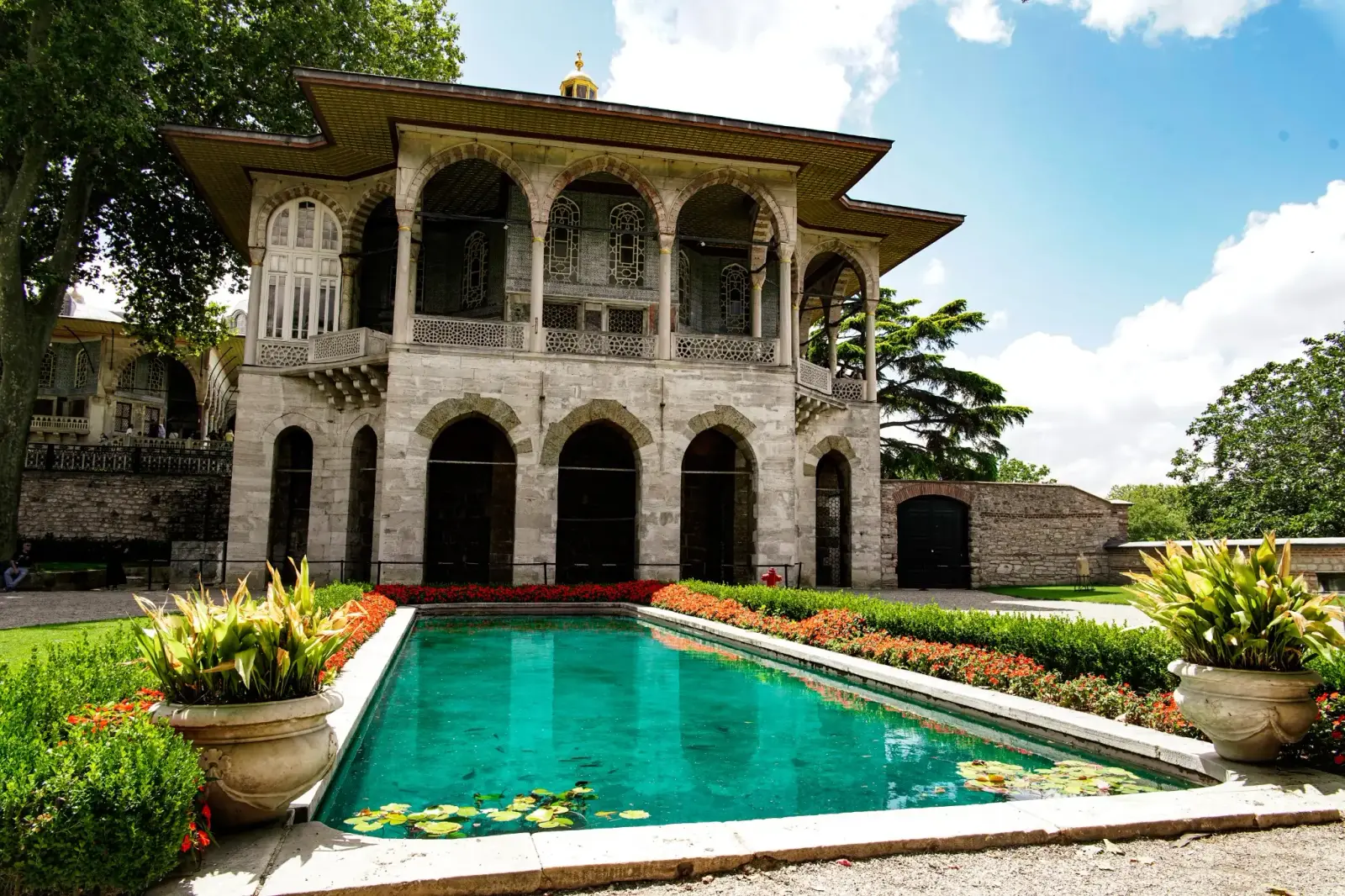
The Baghdad Pavilion beside the terrace pool in the Fourth Courtyard.
04

Fourth Courtyard

Imperial Gardens and Pavilions

The Fourth Courtyard formed the most private and peaceful part of the palace. Its terraced gardens, fountains and pavilions provided spaces for rest, private receptions and contemplation.

From its elevated terraces, visitors can see the Bosphorus, Golden Horn and Asian shore of Istanbul.

Highlights

  • Baghdad Pavilion
  • Revan Pavilion
  • Circumcision Room
  • İftar Pavilion
  • Sofa Mosque
  • Marble Terrace
Fourth Courtyard
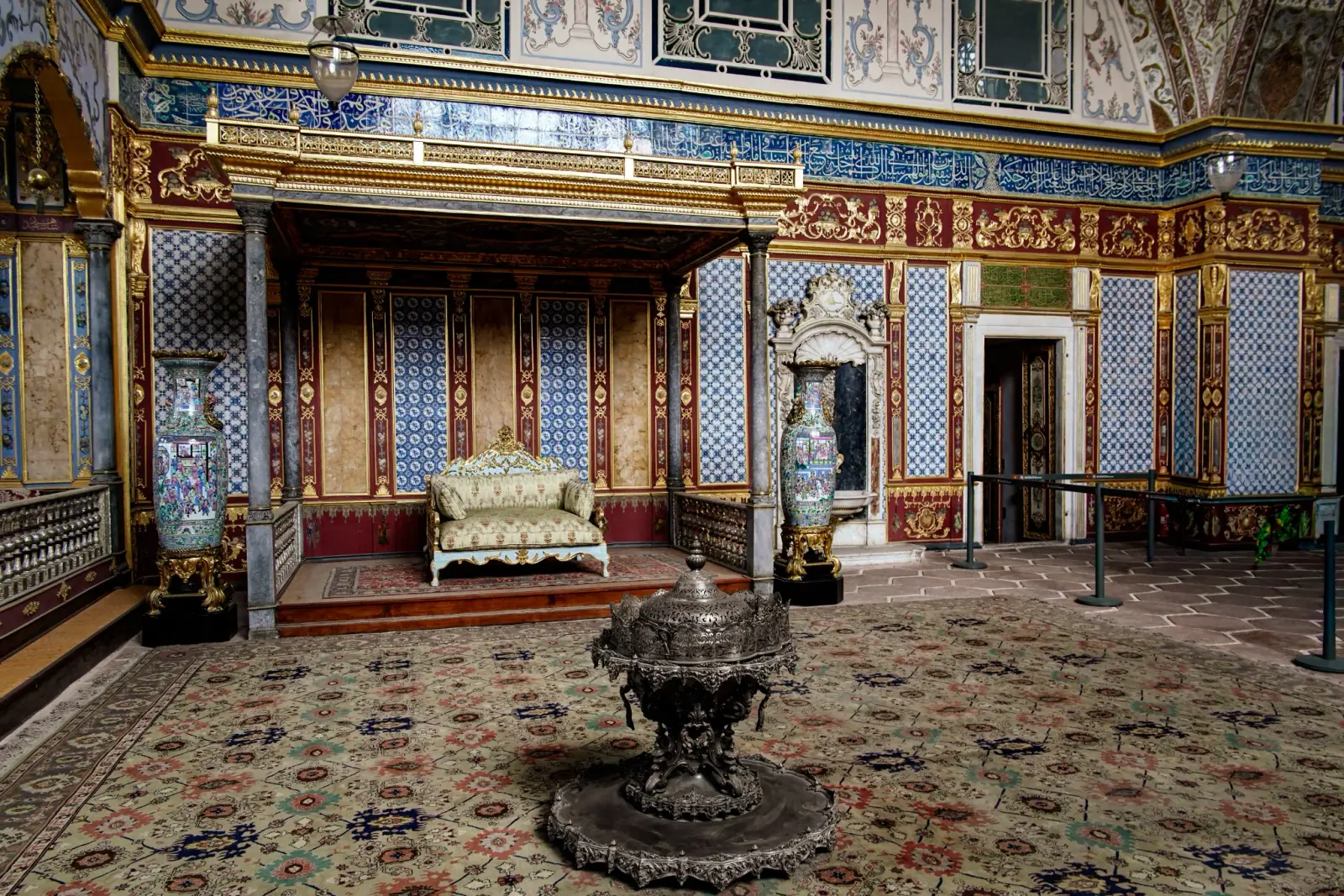
The Imperial Hall with its bronze brazier, the largest ceremonial room in the Harem.

The Imperial Harem

The Private World of the Ottoman Dynasty

The Imperial Harem was the private residential quarter of the sultan, the imperial family and the highly organised household responsible for serving them.

Rather than a single building, the Harem developed over centuries into an extensive complex of apartments, courtyards, baths, corridors, kitchens and service rooms. Its layout reflected the carefully defined hierarchy of palace life.

At the centre of this world stood the Valide Sultan, the mother of the reigning sultan. Her apartments occupied a prominent position within the complex, reflecting her senior status in the imperial household.

The Harem also contained apartments and spaces associated with the sultan, princes, consorts, children of the dynasty, Black Eunuchs and palace attendants. Movement between these areas was regulated by rank, responsibility and court tradition.

Its interiors bring together İznik tiles, stained glass, decorative woodwork, inscriptions, fountains and painted ornament from several periods of Ottoman history. Because successive sultans repaired and expanded the complex, the Harem preserves architectural layers ranging from the classical Ottoman period to later Baroque-influenced decoration.

Recently restored areas have expanded the visitor route, offering a broader view of the residences, service spaces and daily organisation of Harem life.

Discover the Imperial Harem

Rooms and Pavilions

Spaces of Government, Ceremony and Imperial Life

Topkapi Palace contains a remarkable variety of ceremonial chambers, residential rooms and garden pavilions. Each served a particular purpose within the organisation of the Ottoman court.

Imperial Council

The Imperial Council Chamber was where the grand vizier and other senior officials met to discuss military, political, financial and administrative affairs.

A screened window above the council chamber allowed the sultan to listen to meetings without being directly seen, symbolising his authority over the proceedings.

Audience Chamber

Located directly behind the Gate of Felicity, the Audience Chamber was used for formal meetings between the sultan and senior officials.

Foreign ambassadors were also received here after being presented to the Imperial Council, making the chamber one of the palace’s most important diplomatic settings.

Gate of Felicity

The Gate of Felicity separated the administrative Second Courtyard from the restricted Inner Palace.

It served as the symbolic threshold of the sultan’s personal authority and formed the setting for accession ceremonies, religious celebrations and other important court occasions.

Baghdad Pavilion

The Baghdad Pavilion is one of the finest examples of 17th-century Ottoman palace architecture. Its interior is distinguished by İznik tiles, painted decoration, mother-of-pearl inlay and carefully designed windows overlooking Istanbul.

The pavilion was created to commemorate the Ottoman campaign that restored Baghdad to imperial rule.

Revan Pavilion

Built during the reign of Sultan Murad IV, the Revan Pavilion commemorated the Ottoman capture of Yerevan.

Although compact in scale, its tiled interior, central dome and projecting windows create an intimate imperial retreat within the Fourth Courtyard.

Chamber of the Holy Relics

The Chamber of the Holy Relics occupies part of the former Privy Chamber complex, once closely associated with the personal presence of the sultan.

It now houses objects of exceptional religious and historical importance connected with the Prophet Muhammad, the early Islamic period and sacred sites.

Mecidiye Pavilion

Built during the 19th century, the Mecidiye Pavilion represents one of the final major additions to Topkapi Palace.

Its European-influenced decoration and position above the Bosphorus reflect the changing architectural preferences of the late Ottoman court.

View rooms and pavilions

The Imperial Collections

Treasures Preserved Across Centuries

Topkapi Palace preserves collections shaped by centuries of imperial ceremony, diplomacy, craftsmanship, faith and daily court life.

Together, these objects reveal not only the wealth of the Ottoman dynasty but also the artistic and cultural connections between Istanbul, Europe, Asia, the Middle East and North Africa.

  • Imperial Treasury
  • Holy Relics
  • Arms and Armour
  • Ottoman Imperial Costumes
  • Chinese and Japanese Porcelain
  • European Porcelain
  • Manuscripts and Calligraphy
  • Clocks and Scientific Instruments
  • Palace Textiles and Carpets
Explore the Imperial Collections
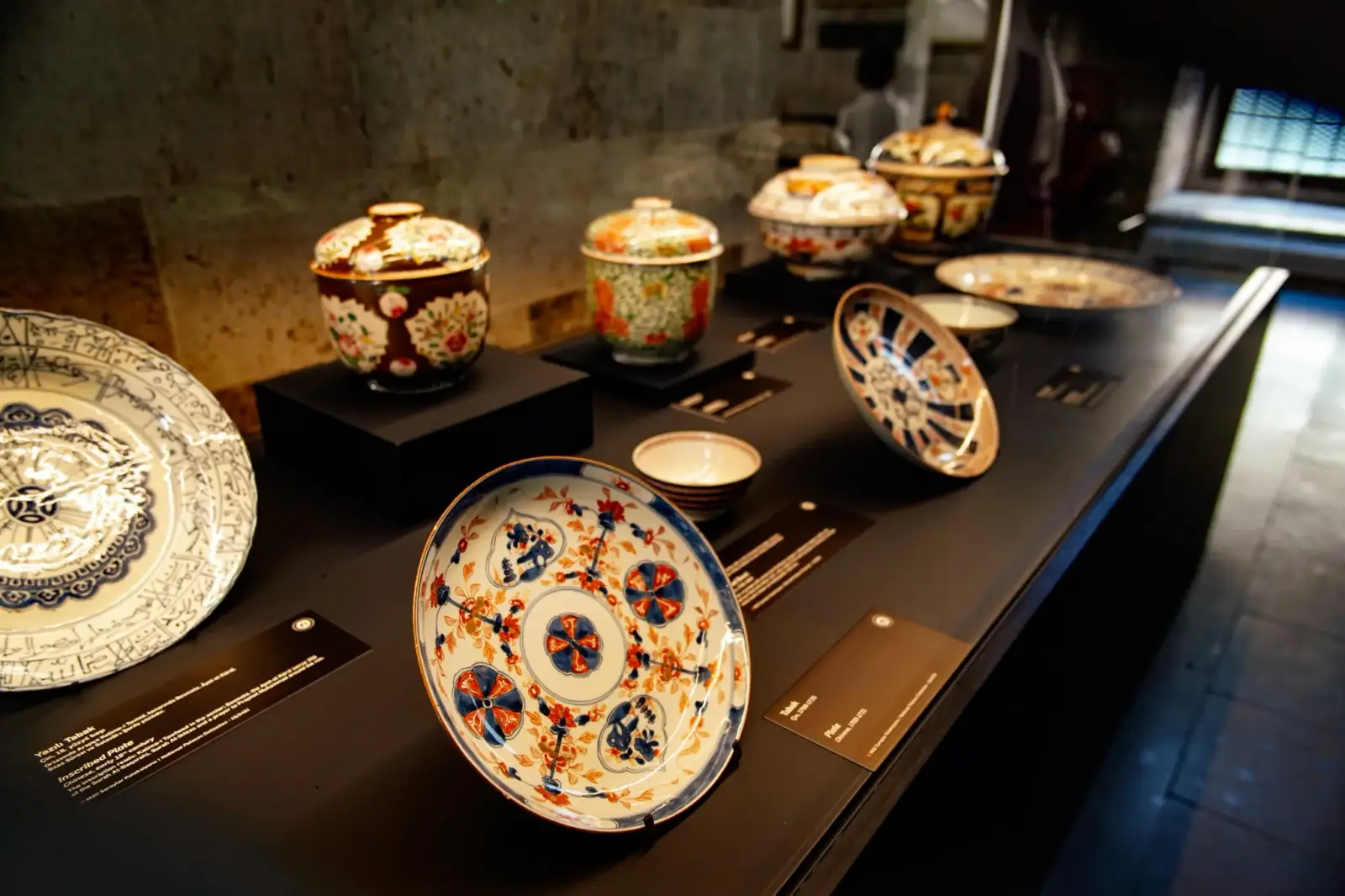
Chinese and Japanese porcelain dishes displayed in the former Palace Kitchens.

Architecture of Topkapi Palace

A Palace Without a Single Facade

Unlike many European royal residences, Topkapi Palace was not conceived as one enormous, symmetrical building. It developed as a collection of courtyards, independent structures, gardens, gateways and pavilions.

The result is an architectural complex that reveals itself gradually. Visitors do not approach a single monumental facade; instead, they move through a sequence of thresholds, each marking a change in function, rank and privacy.

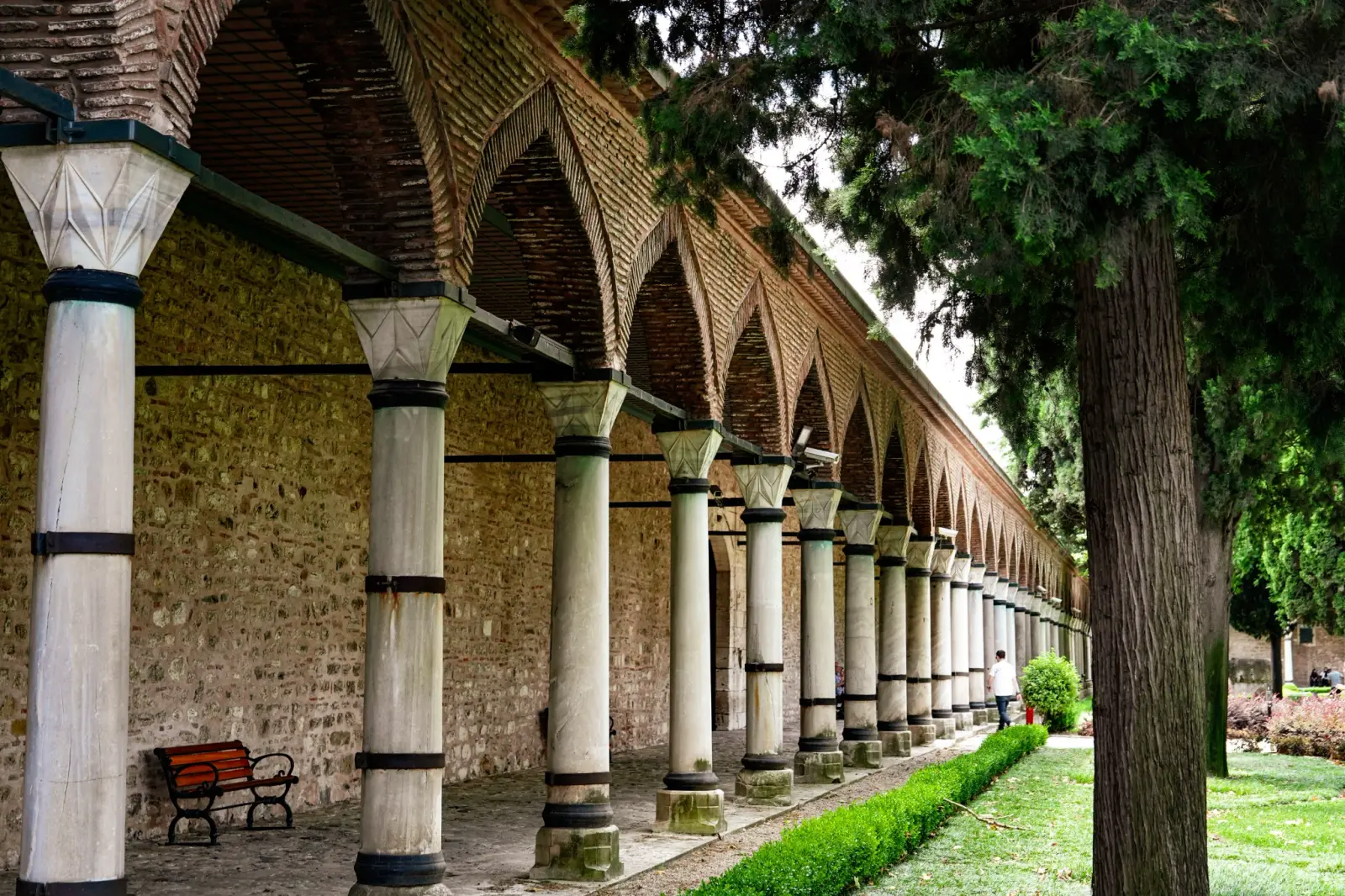
The long arcade of the Palace Kitchens, marble columns carrying brick arches along the Second Courtyard.

Architecture and Hierarchy

The physical arrangement of the palace reflected the organisation of the Ottoman court.

The outer areas accommodated services, administration and controlled public access. Beyond them stood the ceremonial and governmental centre, followed by the Inner Palace and the private world of the imperial household.

Gates were therefore more than entrances. The Imperial Gate, Gate of Salutation and Gate of Felicity each represented a transition into a more restricted sphere of palace life.

Built Across Generations

Topkapi Palace was continually transformed. New buildings were commissioned as the imperial household expanded, court ceremonies changed or different architectural styles became fashionable.

Fires, earthquakes and changing practical needs also led to repeated repairs and reconstruction. For this reason, the palace contains architecture and decoration from many periods rather than representing a single moment in Ottoman history.

Materials and Decoration

Stone, brick, timber, marble and lead-covered domes appear throughout the complex. Open porticoes connect many of the buildings to their surrounding courtyards and gardens.

Inside, İznik tiles, carved marble, gilded inscriptions, stained glass, mother-of-pearl inlay and painted ornament demonstrate the work of generations of court architects and craftsmen.

Decorative choices were closely connected to the purpose of each space. Ceremonial chambers conveyed imperial authority, while residential rooms and garden pavilions created more intimate environments.

Architecture and Landscape

The natural setting was an essential part of the palace design. Gardens, terraces, fountains and carefully framed views softened the transition between buildings.

Pavilions in the Fourth Courtyard were positioned to take advantage of panoramic views across the Bosphorus and Golden Horn. Architecture and landscape worked together to create spaces for ceremony, retreat and contemplation.

This combination of functional organisation, symbolic hierarchy and natural setting gives Topkapi Palace its distinctive architectural identity.

Life at the Palace

A Court, a Government and a Way of Life

Topkapi Palace operated as a complex institution. It was simultaneously the residence of the dynasty, the administrative centre of the empire, a school for future officials and a workplace for a highly organised palace community.

Daily life was shaped by protocol. Rank determined where a person could enter, which ceremonies they attended, how they approached the sultan and where they lived or worked within the palace.

Government and Diplomacy

The Imperial Council formed the centre of government within the palace. Senior officials met under the leadership of the grand vizier to discuss legislation, military campaigns, appointments, finance and petitions submitted from across the empire.

Foreign ambassadors also entered the palace according to carefully arranged ceremonies. Their progress through gates and courtyards was designed to communicate the authority, discipline and scale of the Ottoman state.

Education in the Inner Palace

The Enderun Palace School trained selected young men for service in the highest levels of the Ottoman administration.

Education included languages, religion, literature, calligraphy, music, physical training and court protocol. Advancement depended upon ability, discipline and service.

Graduates could go on to occupy important administrative, military and provincial positions throughout the empire.

The Imperial Household

The dynasty’s private life was centred largely within the Imperial Harem. The Harem was governed by its own hierarchy, rules and responsibilities, with the Valide Sultan holding the highest position after the sultan within the household.

The princes received education intended to prepare them for possible rule. Consorts, attendants, eunuchs and household officials all occupied defined positions within a closely regulated system.

Food and the Palace Kitchens

Food preparation was a major part of palace organisation. The Palace Kitchens supplied meals for the imperial family, officials, palace personnel and guests.

Different kitchen sections were responsible for particular foods, including the sultan’s meals, confectionery, breads, preserves and dishes prepared for various groups within the court.

Meals also played an important ceremonial role. Hospitality, diplomatic receptions and religious occasions required carefully organised preparation and presentation.

Ceremony and Protocol

Court ceremonies marked accessions, religious festivals, military departures, diplomatic audiences and the payment of the Janissaries.

Every detail — from clothing and position to movement and silence — was governed by protocol. These ceremonies reinforced the hierarchy of the court and projected an image of imperial order.

Art, Craftsmanship and Knowledge

The palace supported calligraphers, painters, jewellers, textile workers, armourers, bookbinders and other specialised craftsmen.

Their work served both practical and ceremonial purposes. Manuscripts, weapons, garments and decorative objects produced or preserved within the court reflected the artistic traditions of the empire as well as its diplomatic and commercial connections.

Faith and Tradition

Religion shaped the rhythm of palace life through daily worship, religious festivals, charitable traditions and court ceremonies.

The presence of the Holy Relics gave Topkapi Palace particular spiritual significance. Even after the imperial household moved to the Bosphorus palaces, the sacred collection helped preserve Topkapi’s symbolic place within the dynasty.

A Palace Through Time

PeriodDevelopment
1453Sultan Mehmed II conquers Constantinople and establishes the city as the Ottoman capital.
1460–1478Construction of the New Imperial Palace takes place at Sarayburnu.
16th centuryThe palace expands significantly as the imperial administration and household develop. The Harem becomes an increasingly important part of the complex.
17th centuryNew imperial pavilions, including the Revan and Baghdad pavilions, are added to the Fourth Courtyard.
18th centuryRepairs and new decoration introduce changing Ottoman artistic styles into parts of the palace.
19th centuryNew buildings and European-influenced interiors appear. The imperial household gradually moves to the newer Bosphorus palaces.
3 April 1924Topkapi Palace becomes a museum following the establishment of the Republic of Türkiye.
TodayConservation, restoration and renewed museum displays continue to reveal additional parts of the palace and its collections.

Frequently Asked Questions About Topkapi Palace

What does “Topkapi” mean?

“Topkapi” means “Cannon Gate” in Turkish. The palace was originally known as the New Palace, or Saray-ı Cedid-i Âmire, to distinguish it from the earlier Ottoman palace in Beyazıt. Its present name was adopted later and is associated with a former imperial pavilion known as the Cannon Gate.

When did Topkapi Palace become a museum?

Topkapi Palace officially became a museum on 3 April 1924, shortly after the establishment of the Republic of Türkiye. It was the first museum established during the Republican period.

Why did the Ottoman court move to Dolmabahce Palace?

By the nineteenth century, Topkapi Palace no longer fully met the changing residential, administrative and diplomatic needs of the Ottoman court.

Dolmabahce Palace was built between 1843 and 1856 as a modern imperial residence with larger ceremonial halls and facilities better suited to contemporary state protocol. Sultan Abdülmecid I moved the principal royal residence there in 1856.

Is Topkapi Palace a UNESCO World Heritage Site?

Topkapi Palace forms part of the Historic Areas of Istanbul, which were inscribed on the UNESCO World Heritage List in 1985.

It is located within the Archaeological Park at the tip of Istanbul’s Historic Peninsula and is recognised as one of the outstanding architectural ensembles of the Ottoman period.

Is the Harem part of Topkapi Palace?

Yes. The Imperial Harem is an extensive residential complex within Topkapi Palace rather than a separate palace.

Because it has its own history, hierarchy, architecture and visitor route, it is explored in greater detail on the dedicated Imperial Harem page.

Are all the buildings from the same period?

No. Topkapi Palace developed continuously from the fifteenth to the nineteenth century.

Successive sultans added new apartments, pavilions, service buildings and decorative features. The palace therefore contains architecture and interiors from several periods of Ottoman history, including classical Ottoman, Baroque and Rococo influences.

How much of the original palace survives today?

There is no reliable single percentage that describes how much of the original palace survives.

Many of its principal courtyards, gates, chambers and pavilions remain, but the complex changed repeatedly over the centuries. The historic palace grounds once covered approximately 700,000 square metres, while the museum and its present grounds cover nearly 350,000 square metres, excluding Gülhane Park, which was formerly part of the outer palace gardens.

What is the difference between Topkapi Palace and Dolmabahce Palace?

Topkapi Palace was developed as a collection of courtyards, gardens, pavilions and specialised buildings. Its layout reflects the administrative structure, ceremonial traditions and controlled hierarchy of the classical Ottoman court.

Dolmabahce Palace is a monumental nineteenth-century waterfront residence organised around one principal building. Its interiors combine Ottoman traditions with European Baroque, Rococo and Neoclassical influences.

Together, the two palaces represent different periods of Ottoman history: Topkapi reflects the classical imperial court, while Dolmabahce reflects the modernising empire of the nineteenth century.

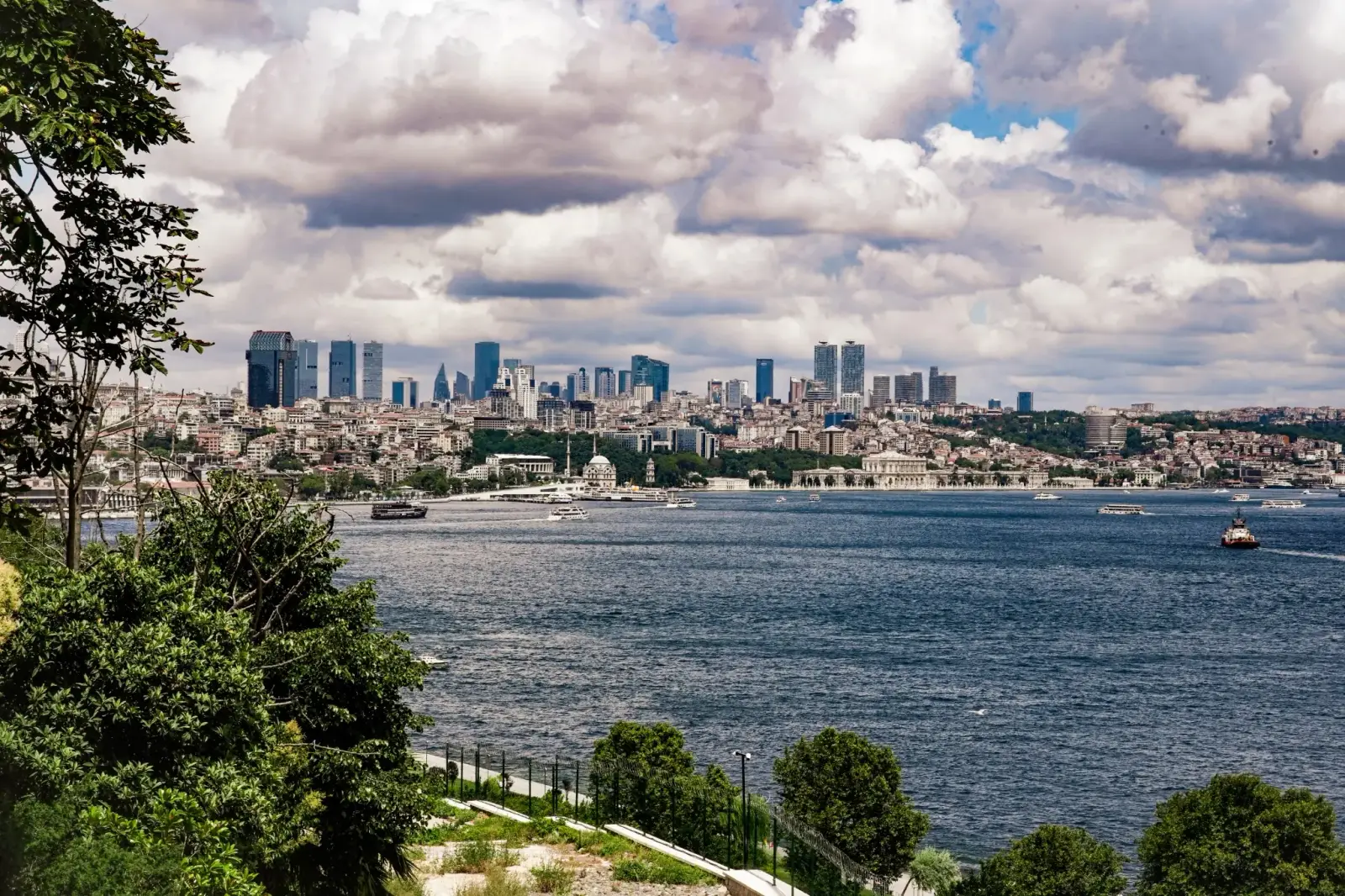
The Golden Horn and the towers of Beyoğlu seen from the palace terraces.

Experience Topkapi Palace

Walk through imperial courtyards, enter private chambers and discover the spaces that shaped almost four centuries of Ottoman history.

View tickets