Third Courtyard
The Inner Palace
The Gate of Felicity marks the entrance to the Third Courtyard, historically known as the Inner Palace. Access to this area was closely controlled, and entry took place according to strict court protocol.
The courtyard contained the Audience Chamber, where the sultan received senior officials and foreign ambassadors, as well as the Enderun Palace School, Imperial Treasury and Privy Chamber.
Gate of Felicity
The Gate of Felicity, known in Ottoman Turkish as Babüssaade or Bab-üs Saadet, was constructed in the mid-15th century under Sultan Mehmed II the Conqueror as part of the original layout of Topkapi Palace after the Ottoman conquest of Constantinople. It formed the critical threshold between the Second Courtyard — the outer administrative and ceremonial zone — and the Third Courtyard, which was the Inner Palace, or Enderun, establishing a strict spatial hierarchy that reflected the sultan’s seclusion and absolute authority. Over the centuries it underwent multiple repairs and stylistic updates, most notably a major redecoration in the rococo style in 1774 under Sultan Mustafa III and further work during the reign of Mahmud II, giving it much of its present appearance while preserving its foundational 15th-century role as a symbol of imperial power and the boundary of the sultan’s private domain.
In daily palace life, the gate served as the exclusive entrance to the sultan’s private quarters, to the Enderun school for students, to the Audience Chamber, to the Imperial Treasury and to related inner structures. The passage was rigorously controlled by the Chief of the White Eunuchs — the Kapı Ağası — and his staff, and even the grand vizier could cross it only on designated days with explicit permission. Ceremonially it was far more significant: the sultan’s throne was placed directly in front of the gate for accession ceremonies, also known as Cülus, in which officials swore allegiance; for Bayram greetings at religious festivals; for imperial funerals; and for the solemn presentation of the Holy Banner — the Sancak-ı Şerif — to commanders departing on campaign. These rituals, conducted under the gate’s canopy, visually reinforced the sultan’s semi-divine status and the absolute separation between the outer world of state administration and the inner world of the sovereign.
The gate is a domed structure supported by slender marble columns, fronted by a broad portico or canopy with sweeping eaves. Its current decorative scheme blends Ottoman and European influences: the ceiling is painted and gold-leafed with a golden ball suspended from the centre, the archway bears verses from the Quran and imperial tughras — the imperial monograms — and the sides feature baroque elements together with landscape frescoes. White-marble columns with ornate capitals, gilded details and a generally elegant rather than purely defensive character distinguish it from the more fortress-like outer gates; the overall effect is one of refined ceremonial presence rather than monumental grandeur.
The Gate of Felicity stands as a well-preserved and highly visited feature of the Topkapi Palace Museum, which has operated as a public museum since 1924 and forms part of the UNESCO World Heritage Historic Areas of Istanbul. Visitors can freely approach and photograph the gate from the Second Courtyard and pass through it into the Third Courtyard to view the Audience Chamber, the Library of Ahmed III, the Treasury and the Sacred Relics chambers. It remains a key photographic and educational highlight, often framed by costumed guards in historical attire, and continues to illustrate the hierarchical organisation and ceremonial life of the Ottoman court for modern audiences.
Audience Chamber
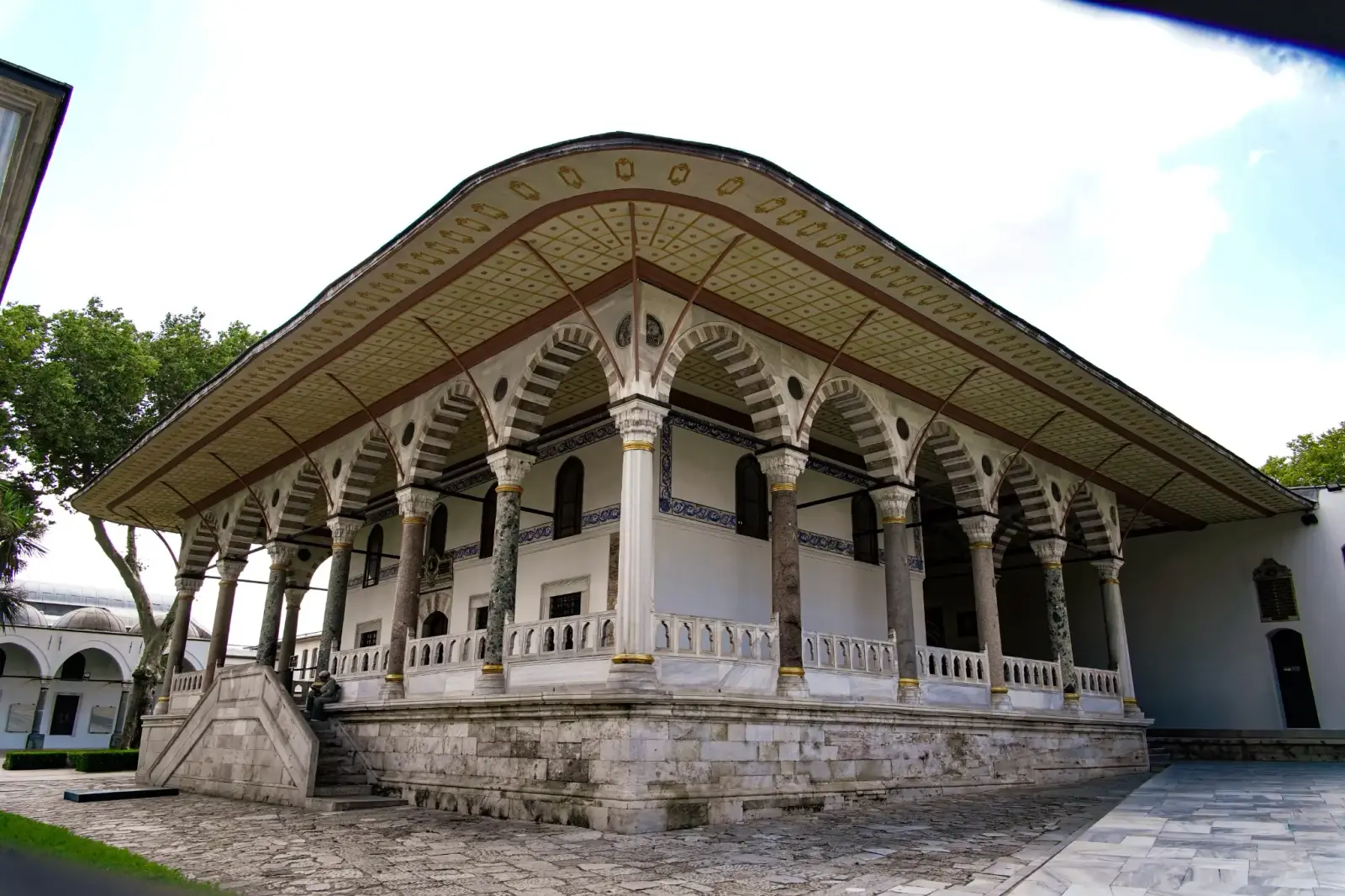
The Audience Chamber, also known as the Chamber of Petitions — Arz Odası — stands directly behind the Gate of Felicity in the Third Courtyard and was originally constructed in the late 15th century under Sultan Mehmed II the Conqueror as a freestanding pavilion dedicated solely to official audiences. It served as the formal throne room where the sultan received the grand vizier, high-ranking state officials and foreign ambassadors in carefully staged ceremonies that emphasised hierarchical distance and imperial authority. Petitioners typically remained standing near the entrance while the sultan sat on a canopied throne, and gifts were presented through a specially designated door and grated window. The building underwent major rebuilding during the reign of Süleyman the Magnificent around 1526–1528, further renewals under Mehmed III including the throne canopy in 1597–1598, and significant restoration after a fire in 1856, yet its core function as the primary venue for high-level diplomacy and private council meetings remained consistent for centuries.
It is a classic example of an Ottoman kiosk: a rectangular, raised structure roughly 16 by 10 metres in the main enclosed space, surrounded on all sides by a colonnaded portico of marble columns that support a broad, overhanging roof with deep eaves. The interior originally featured walls lined with blue, white and turquoise İznik tiles, a wooden dome painted ultramarine blue and studded with golden stars, and a gilded throne canopy — a baldachin — set on a raised divan in one corner; adjacent to the main hall was a small ablution chamber. After the 1856 fire much of the original tilework and ornate woodwork was lost and the roof was altered from a dome to a flatter form, while later 19th-century work introduced Empire-style door and window frames, yet the overall porticoed form and spatial layout have been preserved.
The Audience Chamber is an integral and fully accessible part of the Topkapi Palace Museum. Visitors enter the Third Courtyard through the Gate of Felicity and immediately encounter the building, which can be viewed both from the exterior colonnade and, when open, from the interior, where a reconstructed throne arrangement and interpretive displays help convey its former ceremonial role. Regular conservation work has maintained its structure, and it remains one of the most visited highlights of the palace complex, illustrating the refined spatial and protocol systems of Ottoman imperial power for contemporary audiences.
Enderun Library
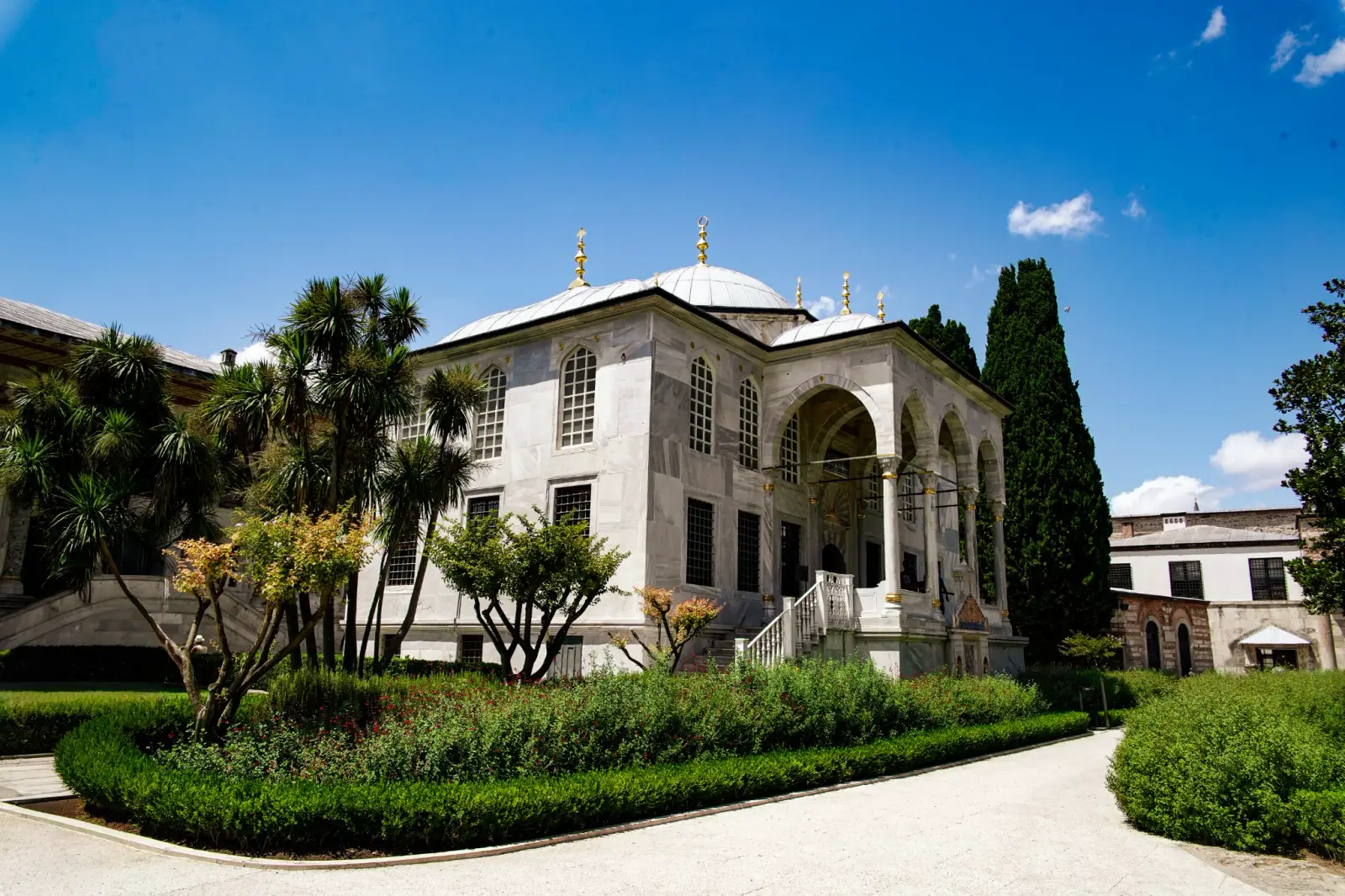
The Enderun Library, also known as the Library of Ahmed III or III. Ahmed Kütüphanesi, was commissioned by Sultan Ahmed III and constructed in 1719 during the culturally flourishing Tulip Period — the Lâle Devri. It replaced an earlier, neglected pavilion known as the Havuzlu Köşk, built under Selim II by the architect Sinan, which stood in the centre of the Third Courtyard behind the Audience Chamber. The sultan ordered the new building specifically to gather scattered manuscripts from various palace treasuries, from the Has Oda and from other locations into a single, purpose-built structure, so that they could be properly preserved and made accessible rather than remaining unused in storage. Construction began in February 1719 with a ceremonial foundation-laying in which Ahmed III himself used a symbolic golden pickaxe associated with his grandfather Ahmed I, and the library was formally opened in November of the same year under a detailed endowment deed — the Vakfiye — that regulated its purpose, staffing and rules.
The library functioned primarily as a working research and study space for the elite pages and scholars of the Enderun school, as well as for the sultan and high-ranking palace officials. Its collection of theological, scientific, legal, literary and historical manuscripts in Ottoman Turkish, Arabic and Persian was actively consulted rather than merely stored. A dedicated reading alcove opposite the entrance served as the sultan’s private study, while the main hall and side iwans allowed controlled access according to the endowment rules, which prohibited books from leaving the premises.
Enderun pages who studied its volumes formed the administrative elite of the empire and frequently rose to the highest offices, including the grand vizierate, thereby linking the library closely to the training of future state leaders.
The library is a refined Tulip-Period pavilion in the form of a Greek cross, raised on a high basement to protect the books from dampness. A central square hall under a dome opens onto three rectangular iwans — side halls — covered by vaults, while the fourth arm consists of a three-arched portico reached by twin staircases and supported by marble columns. The entire exterior is clad in white marble; the entrance façade features an elegant fountain with rumî reliefs and drinking taps dated 1719. Inside, the walls are richly decorated with İznik tiles, painted and stuccoed domes, and mother-of-pearl and ivory-inlaid wooden bookcases and window shutters, creating an intimate yet luminous interior lit by numerous windows.
Today the Enderun Library remains a well-preserved and highly visited component of the Topkapi Palace Museum. Its manuscript collection was transferred in 1966 to the nearby Ağalar Mosque — now the main Topkapi Palace Library — so the building itself no longer houses the original books, yet the structure continues to be open to the public after successive restorations, the most recent major campaign completed between 2014 and 2018. Visitors can admire the marble exterior, the portico fountain and the richly decorated interior, which still conveys the intellectual and aesthetic ideals of the Tulip Period at the heart of the Third Courtyard.
Imperial Treasury
The Imperial Treasury, also known as the Hazine-i Hümayun or Enderun Hazinesi, is housed in the Fatih Köşkü — the Conqueror’s Pavilion — and is one of the oldest structures in Topkapi Palace. Built around 1462–1463 by Sultan Mehmed II the Conqueror shortly after the conquest of Constantinople, it originally served as a private residential and viewing pavilion for the sultan at a commanding corner of the Third Courtyard. Over time its secure location and solid construction led to its transformation into the Inner Treasury, the most closely guarded repository of the dynasty’s personal wealth and the empire’s strategic reserves — distinct from the Outer Treasury in the Second Courtyard, which handled day-to-day state finances.
As the Inner Treasury, it stored the sultan’s most precious personal and dynastic possessions under the supervision of the Chief Treasurer, the Hazinedarbaşı. These included gold and silver bullion and coinage, jewels and gemstones — among them the famous 86-carat Spoonmaker’s Diamond — ceremonial thrones and weapons, jewelled daggers and swords, valuable kaftans and textiles, diplomatic gifts, war booty, artworks and other high-value objects accumulated over centuries. The subterranean vaults held bulk currency and heavier items, while the upper chambers safeguarded the rarest jewels and ceremonial pieces; transfers from this reserve to the Outer Treasury were made only by the sultan’s direct order, in times of war, deficit or crisis.
The building is a robust ashlar-masonry pavilion of four interconnected halls arranged in an L-shape, raised above thick-walled subterranean vaults. The upper rooms open onto a marble colonnade with round arches and Italianate composite capitals, and a corner loggia or belvedere once offered panoramic views over the Sea of Marmara, the Bosphorus and the Golden Horn. Features such as fireplaces, niches, hidden stairways to the basements and deep windows reflect its original residential character, while the massive walls, iron-barred openings and heavily locked doors later reinforced its role as an impregnable strongroom.
The Fatih Köşkü continues to house the Imperial Treasury section of the Topkapi Palace Museum. After successive restorations, including major work completed in recent years, its rooms display many of the original treasures in modern, climate-controlled cases. Visitors can view iconic objects such as the Spoonmaker’s Diamond, the emerald-studded Topkapi Dagger, jewelled thrones and ceremonial arms while walking a one-way route through the historic chambers. Photography is generally restricted inside, and the section remains one of the most popular attractions within the palace complex.
Privy Chamber
The Privy Chamber, originally known as the Has Oda, was constructed in the late 15th century under Sultan Mehmed II the Conqueror as part of the earliest core of the Third Courtyard. Positioned in the north-western corner overlooking the hanging gardens and connecting toward the Harem, it served as the sultan’s principal private residence, throne room and bedroom. After Selim I the Grim’s conquest of Egypt in 1517, the building acquired profound new significance when the Sacred Relics — the Mukaddes Emanetler — were brought to Istanbul and gradually housed there; by the reign of Mahmud II in the early 19th century it had been fully dedicated to these holy objects and became known as the Chamber of the Blessed Mantle, the Hırka-i Saadet Dairesi.
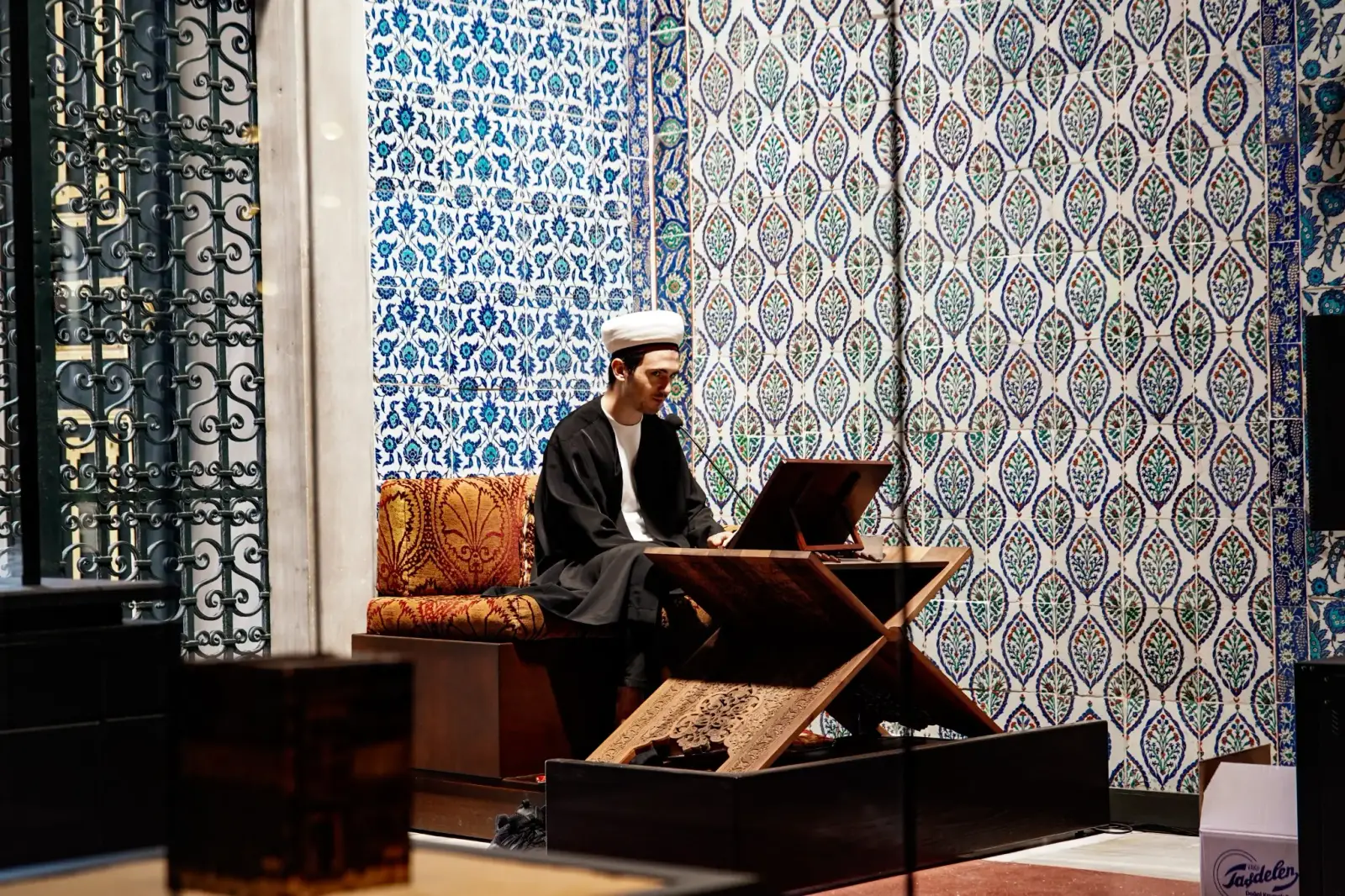
In its early centuries the Has Oda functioned as the sultan’s intimate living quarters, attended by the elite pages of the Has Odalılar. It was the site of private audiences, rest and daily life within the male inner palace. Once the Sacred Relics arrived, its role evolved into that of a sacred shrine. The sultan and selected officials performed annual ceremonial visits, especially on the 15th day of Ramadan, to venerate the objects. Continuous Quranic recitation began as a tradition under Selim I and has continued almost without interruption for over five centuries, reinforcing the chamber’s dual identity as both a former imperial residence and the spiritual heart of the Ottoman caliphate.
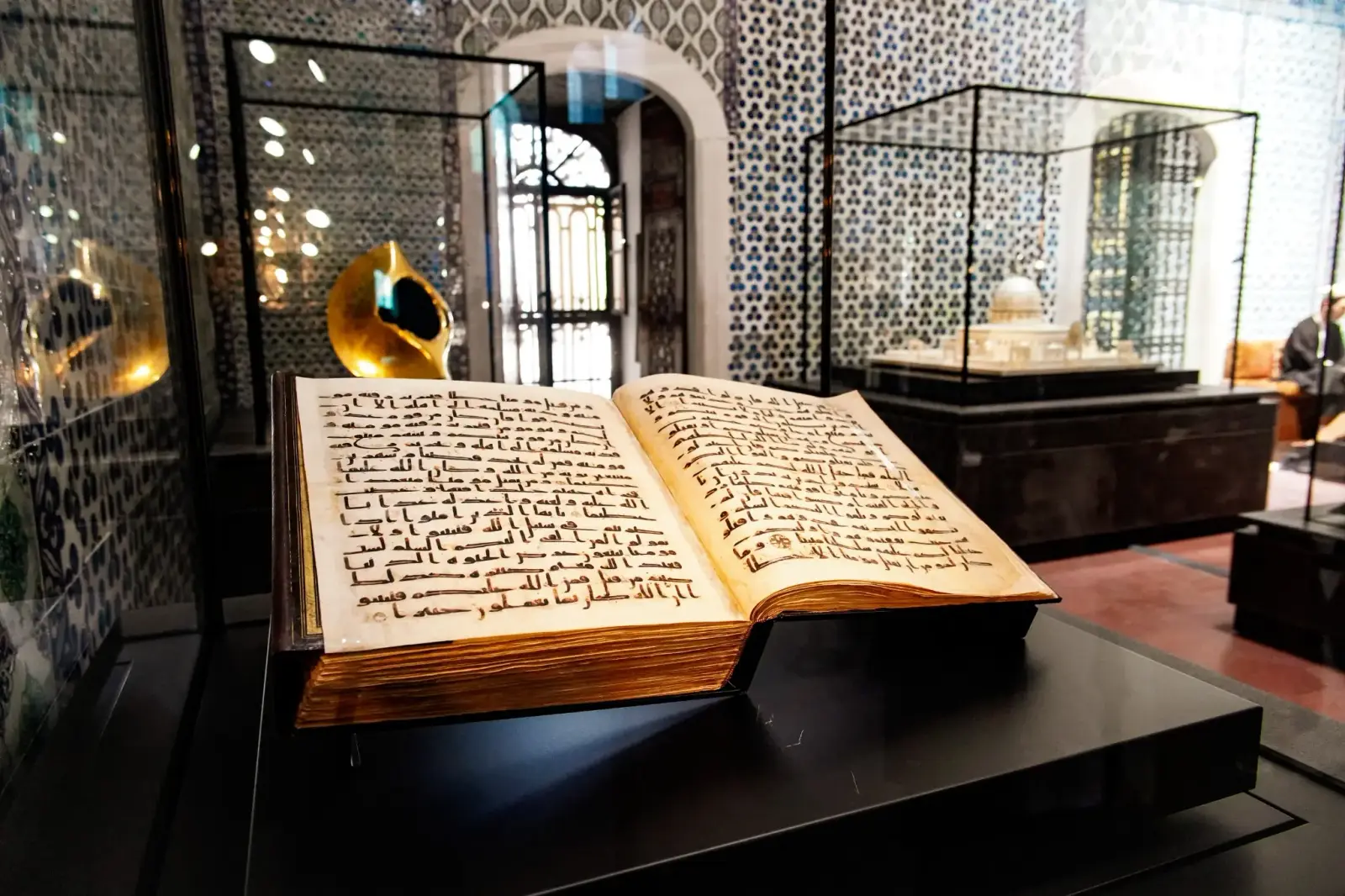
The chamber stores one of the world’s most important collections of Islamic sacred relics, primarily objects associated with the Prophet Muhammad, the Rightly Guided Caliphs, the Companions and earlier prophets, as well as items linked to the Kaaba.
- Relics of the Prophet Muhammad (PBUH)
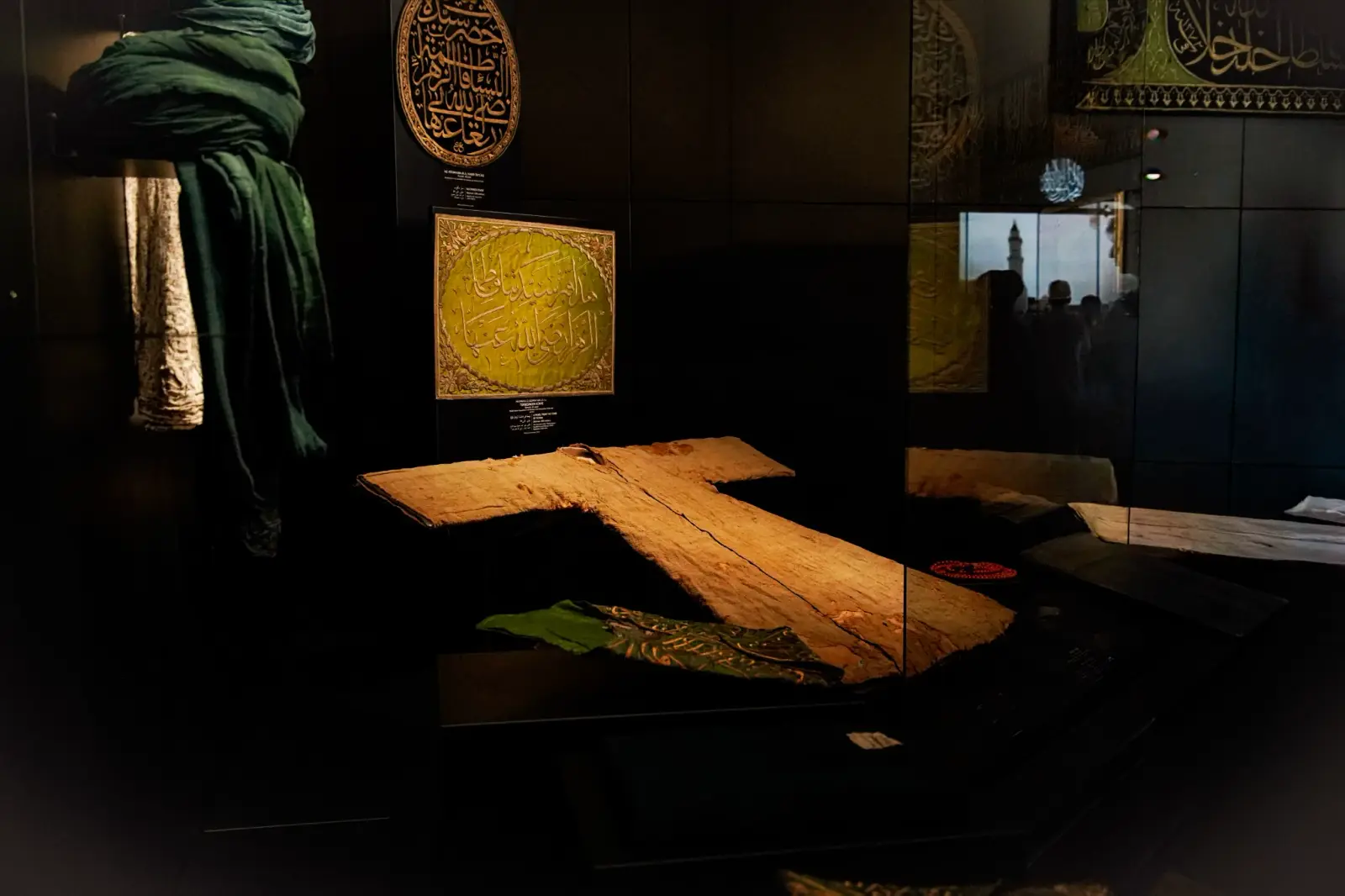
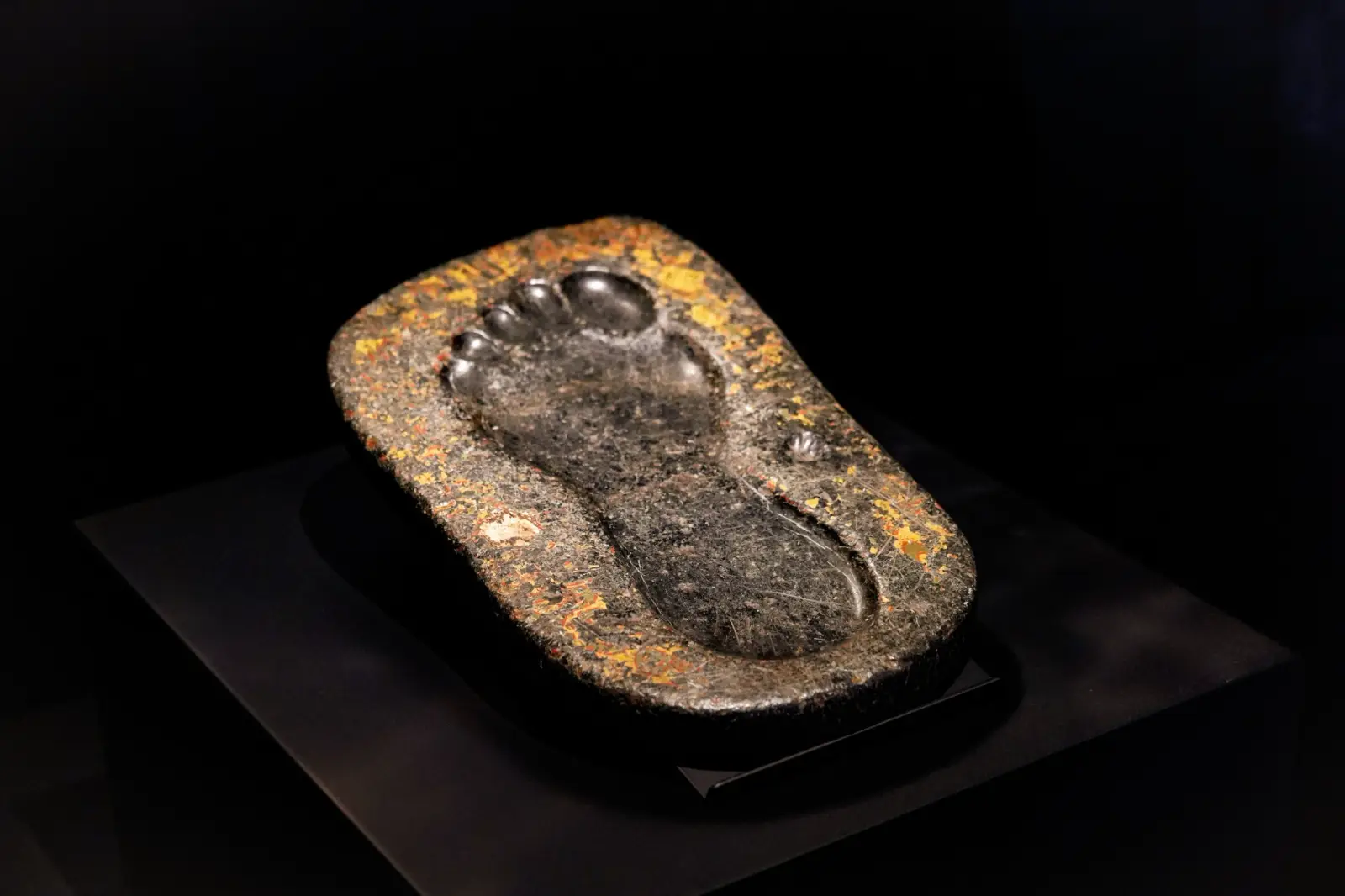
- The most revered item is the Blessed Mantle, the Hırka-i Saadet or Hırka-i Şerif, a black woollen cloak traditionally given by the Prophet to the poet Ka‘b ibn Zuhayr. It is kept in a gold-embellished silver chest beneath a latticed canopy and is not usually displayed openly. Other Prophetic relics include strands of the Prophet’s beard — Sakal-ı Şerif — a fragment of a tooth broken at the Battle of Uhud — Dendan-ı Saadet — the Prophet’s footprint, Kadem-i Şerif, his personal seal, Mühr-i Saadet, letters attributed to him, Name-i Saadet, his swords and bow, and the Holy Banner, the Sancak-ı Şerif.
- Relics of the Caliphs and Companions
- Swords belonging to the first four caliphs — Abu Bakr, Omar, Uthman and Ali, including the famous Dhu’l-Fiqar associated with Ali — are displayed, along with weapons linked to other Companions such as Khalid ibn al-Walid. These objects symbolise early Islamic leadership and military history.
- Earlier prophets and the Kaaba
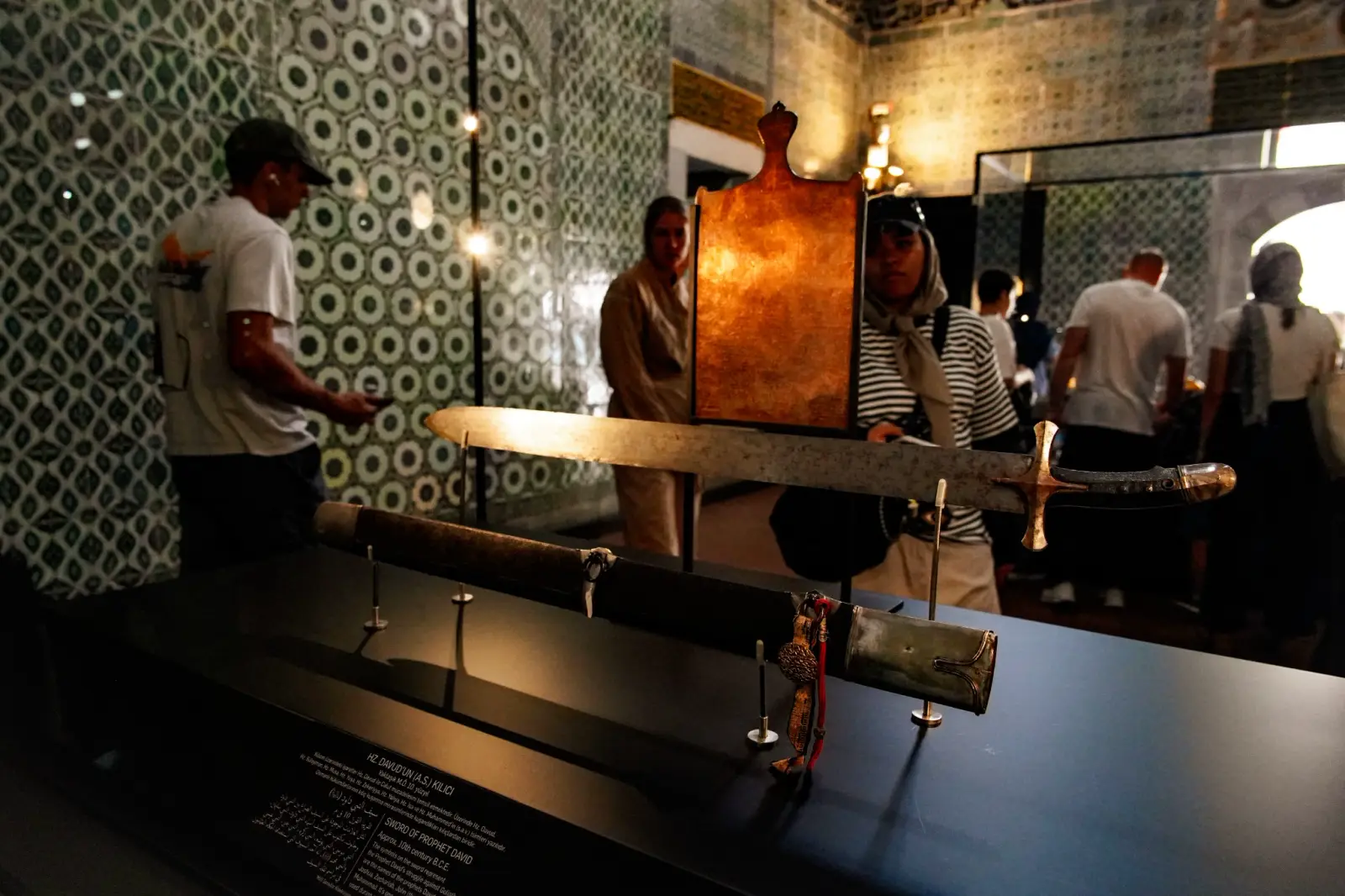
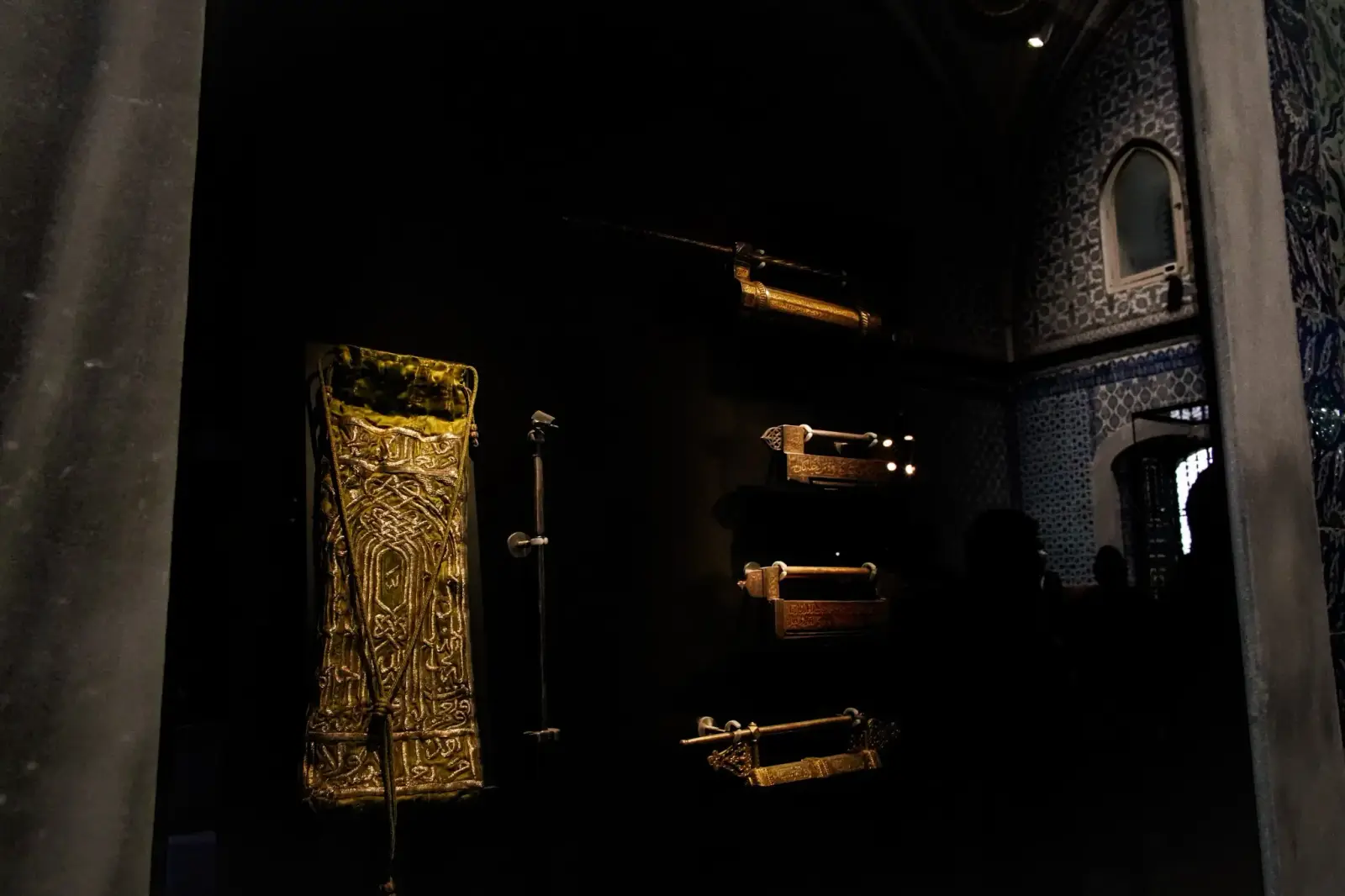
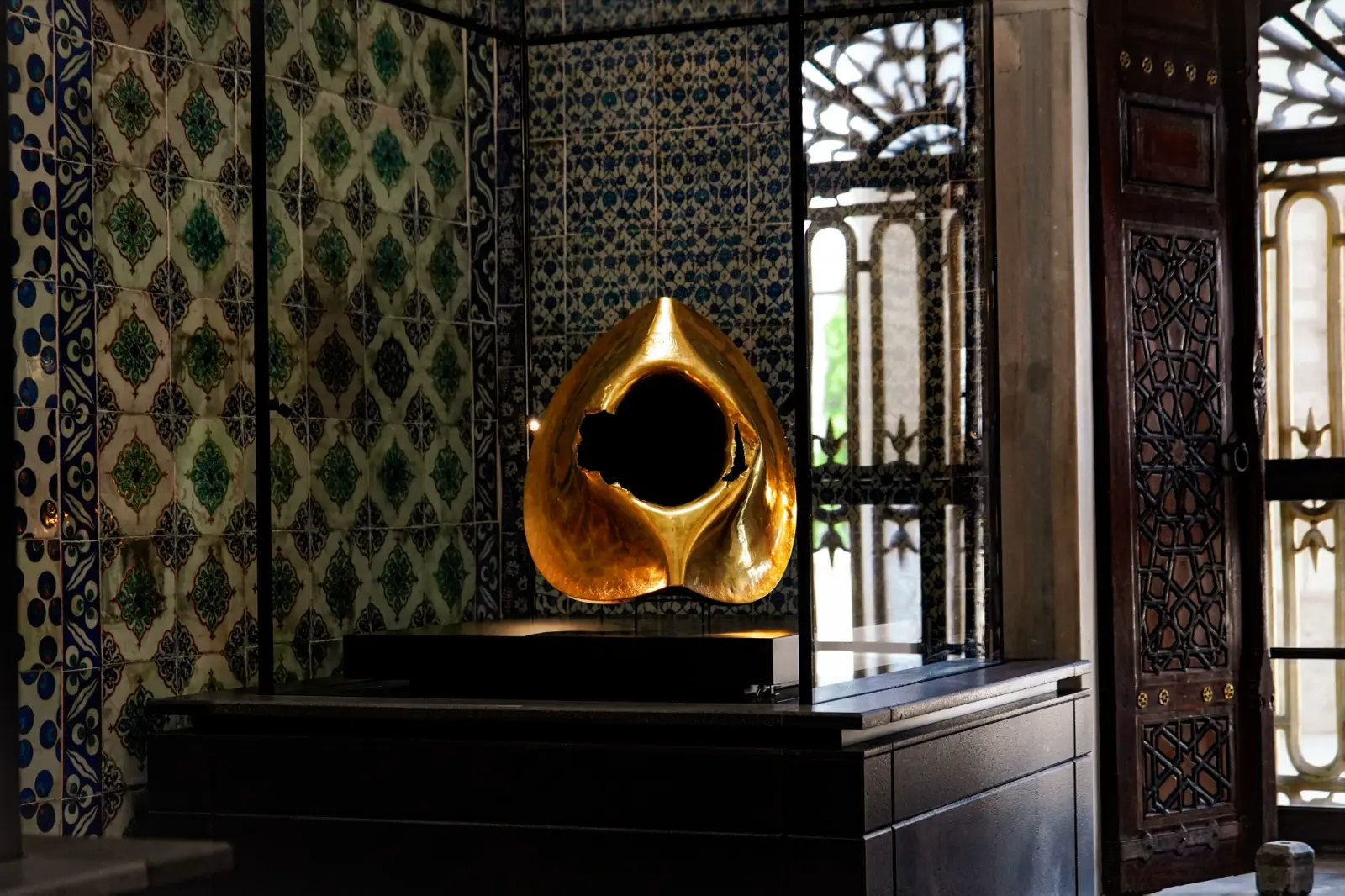
- The collection also includes the Staff of Moses, the Sword of David, Joseph’s Turban, a pot attributed to Abraham and scrolls linked to John the Baptist. From the Kaaba come keys, golden gutters, the casing of the Black Stone — the Hacerü’l-Esved — the Door of Repentance and related fittings. Soil from the Prophet’s tomb and various covers and textiles complete the assemblage.
Visiting the Privy Chamber
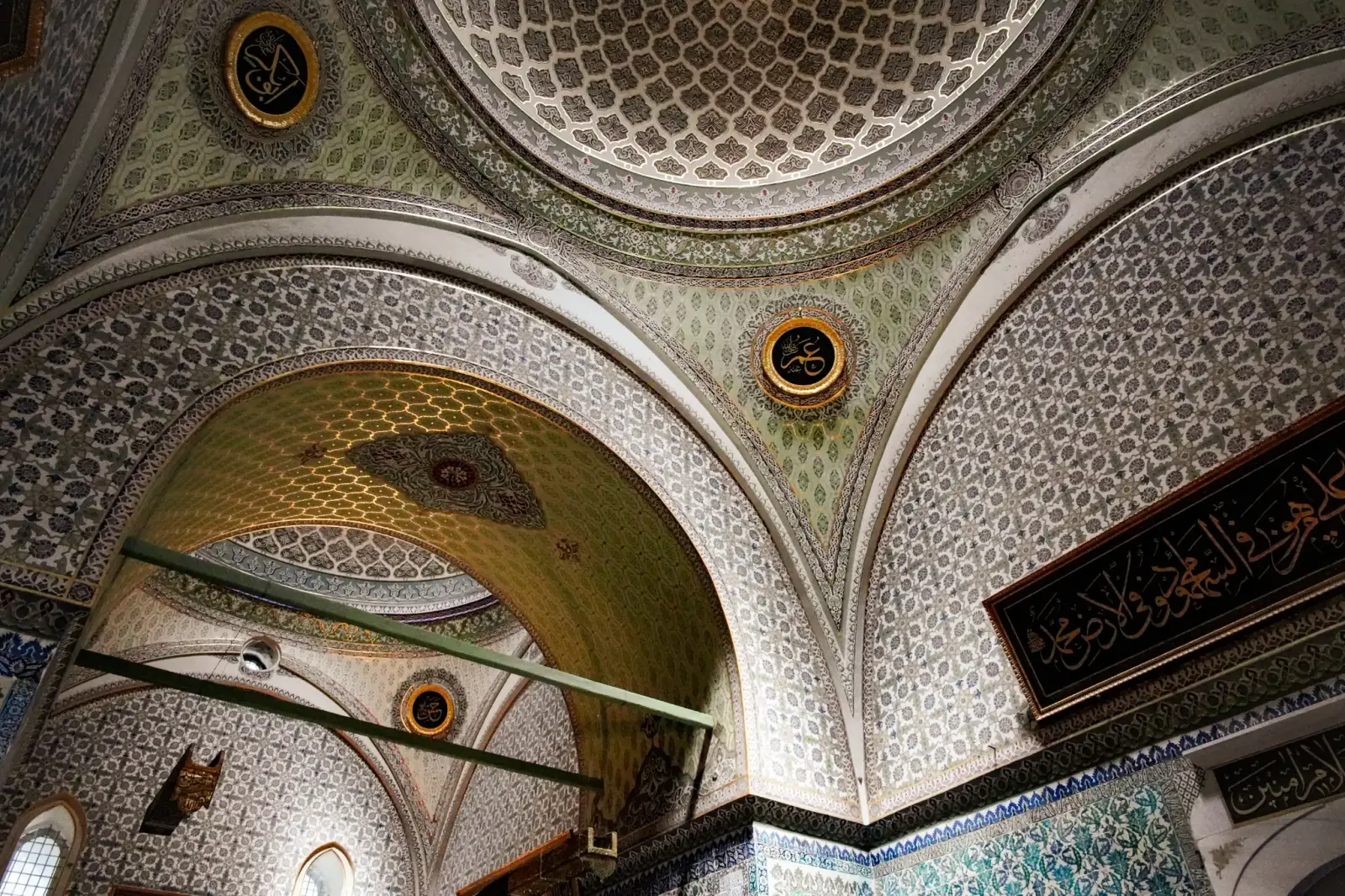
It is a four-domed stone pavilion of roughly square plan, raised above vaulted lower chambers and originally framed by colonnaded porticos. The entrance leads into the Şadırvanlı Sofa — the Fountain Hall — with its marble fountain under a dome; this opens into the principal rooms, including the former throne and bedroom space under the highest dome, which features a lantern and Mamluk-style muqarnas transitions. Interiors are clad in 16th- to 18th-century İznik tiles of floral and geometric patterns, calligraphic bands containing Quranic verses, marble floors and fountains, and later silver latticework and gilded furnishings, creating an atmosphere of refined intimacy suited first to private imperial life and later to sacred veneration.
The Privy Chamber remains one of the most solemn and frequently visited sections of the Topkapi Palace Museum. After successive restorations it is open to the public as part of the standard palace itinerary. Visitors enter through the historic doorway bearing calligraphy by Ahmed III and move through the tiled chambers while continuous Quranic recitation fills the air. Highlights include the silver-canopied enclosure of the Blessed Mantle, the cases displaying the Prophet’s seal, tooth, beard hairs, footprint and swords, the Kaaba-related objects, and the swords of the early caliphs. The combination of original architecture, the living tradition of recitation and the presence of these relics makes the chamber a unique spiritual and historical experience within the Third Courtyard.