
What to Look for When Exploring Topkapi Palace: Details Most Visitors Miss
The palace rewards slow looking: the sequence of the courtyards, the reused Byzantine stone, the joins in the tilework and the sightlines most visitors walk straight past.
Most visitors move relatively quickly through the main courtyards, pause at the famous treasury pieces, and leave with a general impression of grandeur. The real richness of Topkapı, however, lies in slower looking. The palace was designed as a carefully ordered sequence of spaces, and many of its most revealing details are easy to overlook if you are focused only on the big highlights.
The Logic of the Courtyards Themselves
Before examining individual buildings, notice the overall progression. Each courtyard is more restricted than the last. The architecture deliberately stages power through access. Pay attention to how the spaces feel as you move inward. From the relatively open First Courtyard, through the administrative Second, into the more intimate Third and finally to the private terraces of the Fourth. This sequence is one of the palace’s most important “hidden” features.
The Gates as Thresholds of Power
Do not treat the gates as simple entrances.
At the Gate of Salutation (Bâbüsselâm), remember that only the sultan and later the Valide Sultan could pass on horseback while everyone else had to dismount. The act of walking through was itself a form of submission.
Look at the towers of this gate. They once contained cells for high officials who had fallen from favor.
The “Gate of Felicity” (Bâbüssaâde) marks the true entrance to the sultan’s inner domain. Stand for a moment and consider what it meant to cross it.
Tower of Justice and the Hidden Window
In the Second Courtyard, look up at the “Tower of Justice”. Then, if the Imperial Council chamber is open, find the golden latticed window high on the wall. This is one of the most sophisticated political devices in the palace: the sultan could observe the council without being seen. The architecture itself enforced the idea of an all-seeing but invisible authority.
Kitchen Chimneys and the Scale of the Household
In the Second Courtyard, the long row of conical chimneys belonging to the Imperial Kitchens is easy to photograph but often not fully appreciated. These chimneys belong to a complex that once fed 4,000–5,000 people daily and far more on special occasions. They are a reminder that Topkapı was a functioning city as much as a ceremonial stage.
Tilework That Speaks
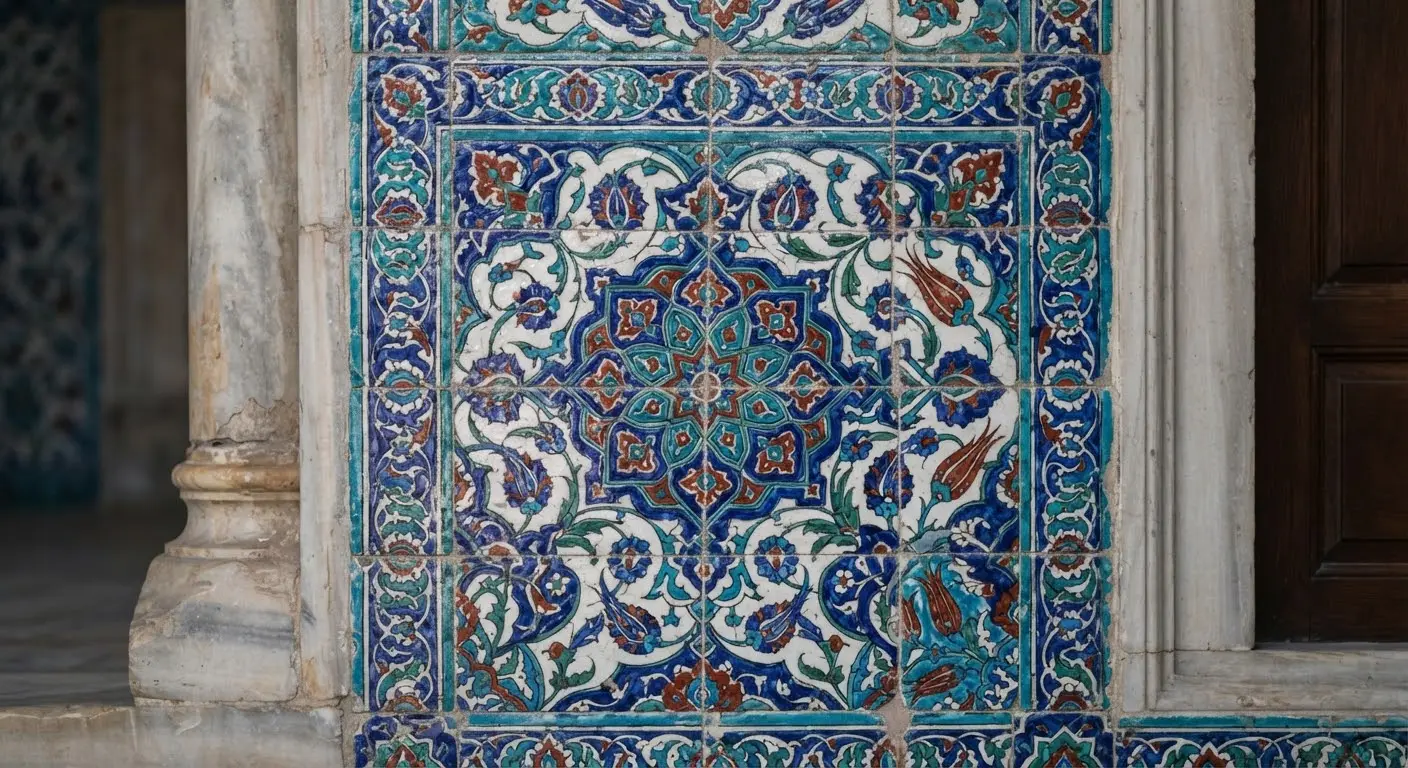
İznik tiles appear throughout the palace especially in the Harem and certain pavilions. Most visitors admire the colors yet fewer notice the symbolic language:
Tulips often allude to divine perfection and the word “Allah.”
Roses are associated with the Prophet Muhammad.
Cypress trees suggest eternity and resilience.
Pomegranates speak of abundance and fertility.
Fourth Courtyard Pavilions and Views
The Baghdad and Revan Kiosks are beautiful but also look at how they are positioned. They were built to commemorate military victories and to frame specific views of the water and the city. The marble İftariye balcony and the terraces are not just scenic. They were places where the sultan could enjoy the panorama while remaining within a controlled, elevated private zone.
Details of Seclusion and Control
Throughout the Harem and private areas, notice the wooden lattices “kafes” screened windows and narrow corridors. These allowed people to see without being fully seen. They are architectural expressions of “mahremiyet” (protected privacy) and the careful management of visibility that defined Ottoman court life.
Layers of Time
Topkapı was never frozen in one period. Look for the mixture of styles: classical Ottoman forms side by side with later baroque or rococo touches especially in eighteenth and nineteenth-century additions. The palace is a physical record of four centuries of continuous use, repair, and changing taste.
What Is Absent or Understated
Unlike European palaces, Topkapı does not rely on a single monumental façade or a grand axial vista. Its power is cumulative and sequential. Noticing what the palace “chooses not to do” its deliberate lack of exterior ostentation is as important as noticing what it displays.
Practical Advice for Seeing More
Arrive early, before the largest tour groups.
Spend extra time in the Second Courtyard especially at Council and Tower of Justice and the Fourth Courtyard terraces.
In the Harem, move slowly through the corridors rather than rushing toward the biggest rooms.
Look up frequently for domes, chimneys, tower and look down for marble paving patterns and thresholds.
Read the inscriptions when you can where calligraphy was a central carrier of meaning.
The visitors who leave with the strongest impression are usually those who treat Topkapı less as a collection of famous objects and more as a carefully designed instrument of hierarchy, seclusion and imperial order. The details most people miss are often the ones that best reveal how the palace actually worked.
From Page to Palace
Reading about the history is only the beginning. Book your visit today and walk the same corridors as the Sultans.