
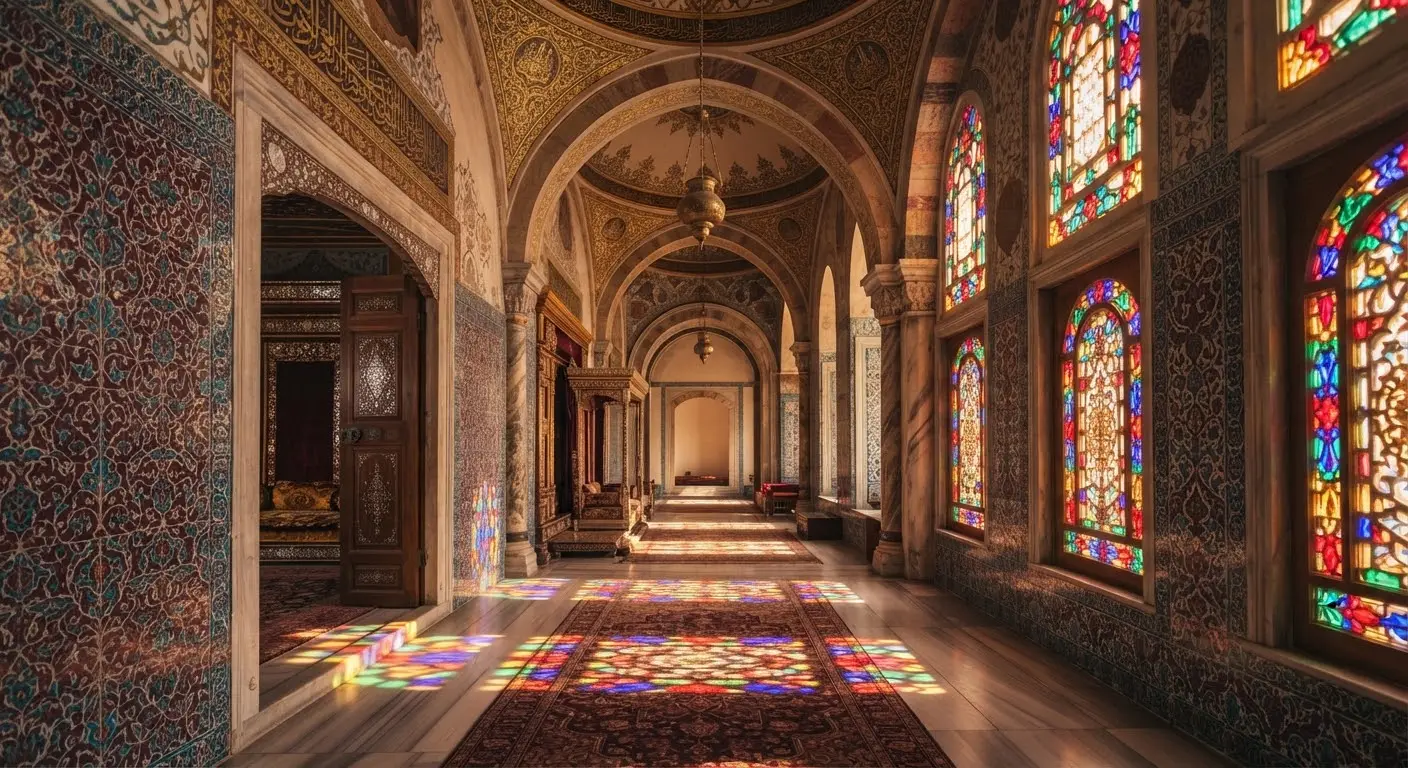
Fascinating Facts About Topkapi Palace You Probably Didn’t Know
Lesser-known facts that go past the harem, the treasury and the view: a Quran recitation unbroken for five centuries, celadon believed to detect poison, and a palace run as a tightly controlled micro-city.
Here are lesser-known, fascinating facts about Topkapı Palace that are more than just the usual tourist highlights of the harem, treasury, and scenery within and outside of the palace. These reveal the palace as a living, tightly controlled micro-city of power, ritual, secrecy, and everyday ingenuity.
1. An unbroken 500-year Quran recitation still continues today
In the Chamber of the Sacred Relics (Has Oda, the Quran has been recited nonstop, day and night, for more than five centuries. It began under Sultan Selim I the Grim after he brought the Prophet’s relics from Egypt. He reportedly ordered 39 hafizes (memorizers) and declared himself the 40th. Today, 28 hafizes still rotate in short shifts so that a full recitation (hatim) is completed every single day — 365 times a year. The tradition has never been interrupted.
2. The “40th person” rule in the Imperial Council
In the Imperial Council (Divan-ı Hümayun), protocol required exactly 39 elite Enderun pages/students to be present. The 40th place was reserved exclusively for the sultan himself. This numerical symbolism reinforced the idea of the ruler as the completing, sacred presence at the heart of the palace’s most intimate space.
3. Chinese celadon porcelain doubled as a poison detector
The imperial kitchens used large quantities of Chinese celadon (especially Longquan ware). Beyond its beauty, Ottoman belief held that the glaze would change color or crack if the food contained poison. This practical superstition helped shape one of the world’s largest surviving collections of Chinese porcelain in the palace.
4. The Fountain of the Executioner
In the Second Courtyard stands a fountain traditionally linked to the palace executioner. After beheadings (often carried out near the Gate of Salutation), the chief swordsman is said to have washed his sword and hands here. The quiet little fountain carries a grim reminder of the absolute power exercised just steps from the audience halls.
5. A whispering gallery for discreet intrigue
Inside the Harem, near the Valide Sultan’s (Queen Mother’s) apartments, there is an acoustically clever space often called a whispering gallery. Soft voices can carry surprisingly far, allowing private conversations without being overheard by others nearby — perfect for the politics and secrets that defined harem life.
6. Sultans had a secret route to mingle with ordinary people
A discrete path/ramp (recently made more accessible to visitors) allowed certain sultans — including Mehmed the Conqueror and later ones such as Mahmud II — to leave the palace in disguise, pass through what is now Gülhane Park, and walk among the public to hear real opinions. The same route was sometimes used for the ceremonial sword-girding procession to Eyüp.
7. The kitchens fed a small city — with extreme security for the sultan’s food
At its height the palace complex housed around 4,000 people and sometimes more during festivals. The vast Matbah-ı Amire kitchens employed hundreds and produced thousands of meals daily. After suspicions surrounding earlier royal deaths, the sultan’s personal food was prepared in a dedicated kitchen, then covered with a cloth and sealed with a ribbon so no one could tamper with it on the journey to his table.
8. The Topkapı Dagger contains a hidden watch
The famous emerald-and-diamond dagger in the Treasury was originally intended as a diplomatic gift from Sultan Mahmud I to Nadir Shah of Persia. Couriers turned back when news arrived that the Shah had been assassinated. A tiny watch is concealed in the hilt — a subtle reminder that time (and power) is always running out.
9. Dozens of underground cisterns and wells still lie beneath the complex
Archaeological work has identified roughly 20–26 cisterns and nearly 30 wells under the palace grounds, many of Byzantine origin. Some contain intriguing markings (including ship-like graffiti). While dramatic legends of long escape tunnels running all the way to Hagia Sophia or the Basilica Cistern remain largely unproven, the real subterranean network of water systems, service corridors, and voids is extensive and still only partly explored.
10. The Baklava Procession was a major Ramadan spectacle
During Ramadan the palace staged the Baklava Alayı (Baklava Procession). Trays of baklava prepared in the imperial kitchens were ceremonially carried out and distributed, especially to the Janissaries. It was both a display of imperial generosity and a carefully staged public ritual that reinforced the sultan’s role as provider.
These details show Topkapı not just as a museum of glittering objects, but as a meticulously engineered machine of sovereignty, spirituality, surveillance, and daily logistics that operated for centuries. Many of the spaces that held these secrets are still standing if you know where and how quietly to look.
Yes — here are more lesser-known and genuinely intriguing facts about Topkapı Palace that most visitors and even many guidebooks never mention such as:
The sanctity of a dust within Chamber of Sacred Relics
In the Chamber of the Sacred Relics, the dust swept from the rooms housing the Prophet’s mantle and other holy objects was never thrown away. It was carefully collected and poured into a specially dug well out of reverence. This practice underscores how literally the Ottomans treated the presence of the relics.
Only two people could ride through the Gate of Salutation
The Babüsselam (Gate of Salutation) marked the boundary of the sultan’s more private domain. Protocol was strict: only the reigning sultan and the Valide Sultan (Queen Mother) were allowed to pass through on horseback. Everyone else such as viziers, ambassadors, and high officials included had to dismount and walk.
The “Cage” (Kafes) system turned potential sultans into isolated prisoners
After the early practice of fratricide was abandoned, Ottoman princes were confined for years (sometimes decades) in luxurious but heavily restricted apartments known as the kafes. They lived under constant surveillance, often with deaf-mute servants, and were forbidden from having children. Many emerged psychologically damaged; some went mad. The Twin Kiosks in the Harem are the most famous surviving example of these gilded prisons.
The ancient trees in the First Courtyard are mostly hollow
Many of the centuries-old plane and cypress trees that still stand in the First Courtyard are completely hollow inside, hollowed out by fungus. Remarkably, they remain upright and alive which is a quiet botanical oddity that most people walk past without noticing.
An overlooked service ward still holds personal traces of ordinary palace staff
The Zülüflü Baltacılar (Halberdiers with Tresses) Ward the home to the palace’s woodcutters and logistical workers is often skipped by tourists. Excavations and restoration work there have turned up humble personal items such as carved tobacco pipes and pouches with individual initials, offering rare glimpses of the everyday lives of lower-ranking palace servants.
Ornate “bird palaces” stand near the Imperial Mint
Near the Imperial Mint in the First Courtyard are finely carved Ottoman kuş sarayları (bird palaces or bird kiosks). These miniature architectural structures, complete with tiny cupolas, latticework, and balconies, were built as nesting places for sparrows, swallows, and other birds to reflect the Ottoman cultural and religious respect for animals.
Red or white sherbet decided a man’s fate
At the Balıkhane Kiosk near the old Fish House Gate, dismissed grand viziers and high officials were sometimes summoned. The color of the sherbet they were offered carried a clear message: red meant execution, white meant exile. The quiet ritual turned a simple drink into a death sentence or a banishment order.
The sultan could cancel a Divan meeting with a single knock
During meetings of the Imperial Council (Divan-ı Humayun), the sultan often listened unseen from a latticed window above the chamber (the “Window of Justice”). If he wished to intervene or end the session, he simply knocked on the grille. One knock was enough to stop proceedings and wait for his formal command.
The famous Iznik “coral red” was a lost technical secret
The vivid, slightly raised “coral red” sometimes called “bolu red” that appears on many 16th-century Iznik tiles in the Harem and other rooms was achieved through a difficult chemical process involving iron-rich pigments. The exact formula was perfected around the 1550s and then mysteriously lost by the 17th century — modern attempts to recreate it have never fully matched the original brilliance and relief effect.
A rare 19th-century painting of the Kaaba was recently rediscovered in the palace collections
In recent years, conservators uncovered a large, unsigned 19th-century Ottoman painting of the Masjid al-Haram and the Kaaba that had been stored in the palace collections. It shows architectural details that no longer exist and includes figures of both Anatolian and African appearance, reflecting the multicultural Ottoman administration of the holy sites. The work is now being carefully restored.
These details reveal Topkapı as a place of extreme protocol, quiet symbolism, and layered history where even dust, trees, birdhouses, and the color of a drink carried meaning. The palace still holds more such quiet stories if you look past the main tourist route.
From Page to Palace
Reading about the history is only the beginning. Book your visit today and walk the same corridors as the Sultans.