
Hidden Symbols in Topkapi Palace’s Ottoman Architecture
The grilled window, the deepening courtyards, the placing of a fountain: what looks like decoration was often a deliberate statement about power, justice and seclusion.
Ottoman architecture at Topkapı Palace is rich in layered meanings. Many elements that appear decorative or practical also functioned as deliberate symbols of power, justice, divine order, seclusion and the sultan’s unique status. These symbols operated within the specific historical context of a Muslim empire that valued hierarchical order, the ruler’s semi-sacred authority and controlled visibility.
Here are the principal examples, explained with their historical meanings:
The Sequence of Four Courtyards
The entire palace is organized as a series of successive courtyards of increasing restriction. This spatial progression physically embodied the Ottoman hierarchy of power and access. Moving from the public First Courtyard to the private Third and Fourth Courtyards mirrored the movement from the outer world toward the sacred and absolute center of authority the sultan himself. Architecture itself enforced social rank: the further one could penetrate, the higher one’s status.
The Tower of Justice (Adalet Kulesi) and the Latticed Window
Rising above the Imperial Council (Kubbealtı or Divan-ı Hümayun) in the Second Courtyard is the tallest structure in the palace. Inside the council chamber is a golden latticed window or “kafes” connected to the tower. The tower was a visible symbol of the sultan’s justice and omnipresence, meant to be seen across the city and the Bosphorus. The hidden window allowed the sultan to observe council meetings without being seen. This architectural device expressed the ideal of the ruler as an all-seeing but invisible source of justice but a concept rooted in Islamic and earlier Near Eastern traditions of the just sovereign whose authority does not require constant physical presence.
The Monumental Gates
Each major gate marks a threshold of increasing sacredness and restriction. The Gate of Felicity leading into the Third Courtyard is particularly charged. Gates were not merely entrances. They were ceremonial and symbolic barriers. Only the sultan and later the Valide Sultan could pass the Gate of Salutation on horseback; everyone else had to dismount which was a physical act of submission. The gates staged the drama of approaching imperial power and reinforced the idea that access to the sultan was a carefully controlled privilege.
Domes
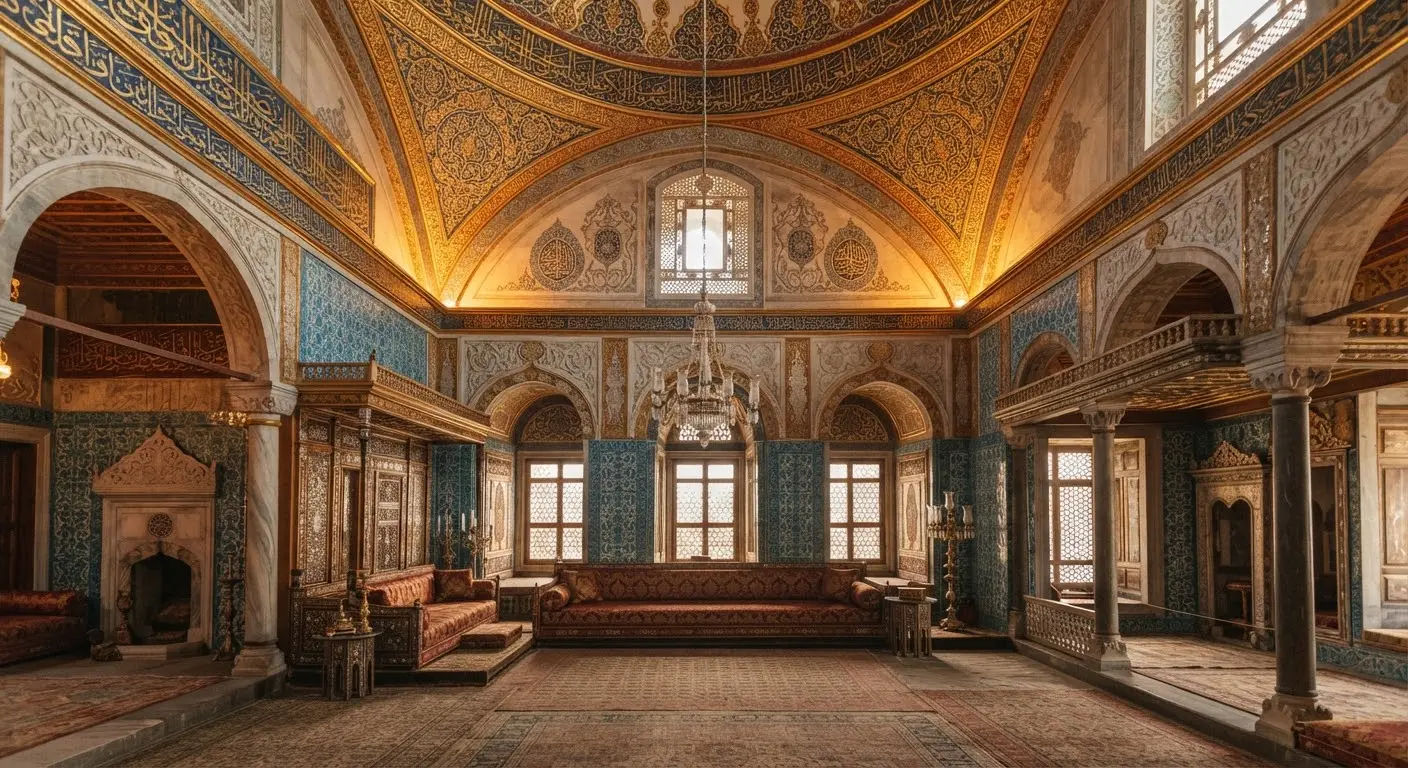
Domes appear over key buildings such as the Council Hall, Audience Chamber, and Privy Chamber. In Islamic architectural tradition, the dome represents the vault of heaven and divine order. Placing a dome over spaces associated with the sultan or high government linked earthly authority to heavenly authority, suggesting that the sultan’s rule participated in cosmic order.
Floral and Botanical Figures in İznik Tilework
Walls and interiors are covered with highly stylized floral patterns. Common motifs and their traditional associations include:
Tulip (lale): Associated with perfection and through the similarity of its letters in Ottoman Turkish to the word “Allah” with divine unity.
Rose: Linked to the Prophet Muhammad and divine love.
Cypress tree: Symbol of eternity, resilience and the soul’s aspiration toward God.
Carnation and other flowers: Renewal, grace and the beauty of creation.
Pomegranate: Fertility and abundance.
These were not random decoration. In a culture that generally avoided figurative human representation in formal and religious contexts, the floral language created a vision of Heaven on earth, turning the palace interiors into symbolic gardens of divine beauty and order.
Calligraphy and Quranic Inscriptions
Many gates, chambers, and pavilions carry elegant calligraphic inscriptions are ornamented often Quranic verses or the sultan’s tuğra (imperial monogram).
Meaning: Writing itself was sacred. Quranic verses sacralized the spaces, while the tuğra asserted the sultan’s personal and dynastic authority as a permanent, almost talismanic mark of legitimate rule.
Lattices, Screens and Controlled Visibility
Throughout the Harem and private apartments, wooden lattices and screened windows appear. These allowed the inhabitants especially women of the Harem and the sultan to see without being fully seen. They embodied the core Ottoman ideal of privacy or “mahremiyet” and the controlled revelation of power. Visibility was a carefully managed resource.
The Number and Placement of Service vs.Ceremonial Buildings
Service structures like kitchens, stables, barracks are placed in the outer courts while the most refined pavilions and the Privy Chamber occupy the innermost zones. The physical separation of mundane labor from the refined center reinforced the hierarchical and almost cosmological ordering of the palace as a microcosm of the empire.
These elements emerged and solidified especially in the 15th and 16th centuries under Mehmed II and Süleyman the Magnificent. They drew on earlier Islamic, Byzantine and Turco-Mongol traditions of rulership while adapting them to Ottoman needs. It is the desire to project absolute yet just authority to maintain the sultan’s semi-sacred seclusion and to make architecture itself an instrument of political and spiritual order. Later periods added European decorative flourishes but the underlying symbolic language of hierarchy, justice and controlled access remained fundamentally Ottoman.
Architectural design of Topkapi Palace itself was a form of silent communication. Every courtyard, gate, tower, dome, lattice and floral pattern participated in a sophisticated system of meanings that told subjects, officials and ambassadors exactly where they stood in relation to the center of power.
From Page to Palace
Reading about the history is only the beginning. Book your visit today and walk the same corridors as the Sultans.