
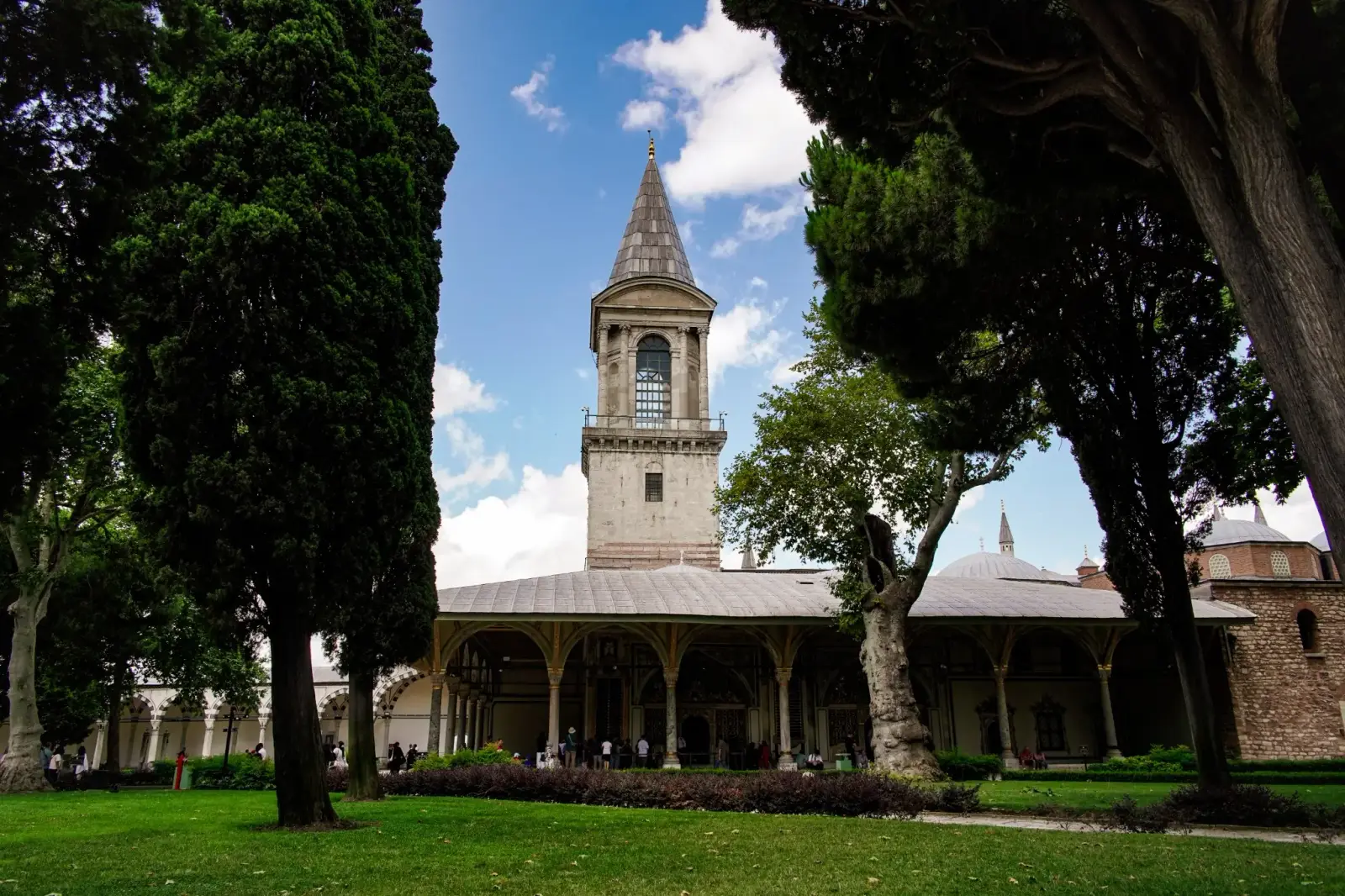
How Topkapi Palace Changed Over 400 Years
The Conqueror’s four-courtyard plan held, but almost every generation rebuilt inside it — fires, expansions, new tastes and shifting politics, layer over layer.
Topkapı Palace was never a finished monument. From its foundation in the mid-fifteenth century until the Ottoman court left it in the mid-nineteenth century, successive sultans continually modified, expanded, repaired and redecorated the complex. What began as Mehmed II the Conqueror’s carefully planned New Palace grew into a sprawling, layered ensemble that reflected the changing needs, tastes and political circumstances of the empire. The basic four-courtyard layout established by the Conqueror remained remarkably stable, yet almost every generation left its mark.
Foundation under Mehmed II (1450s–1481)
Construction began around 1459–1465 on the site of the old Byzantine acropolis at Sarayburnu. Mehmed II created a palace organized around successive courtyards of increasing privacy, surrounded by fortified walls. The core elements like the Imperial Gate, the Middle Gate, the basic structure of the Second and Third Courtyards, the Privy Chamber, and the earliest service buildings date from this foundational period. The palace was conceived as both an administrative center and a residence that was drawing on earlier Ottoman palace traditions especially Edirne while adapting to the dramatic topography of the peninsula.
Early Expansions and the 1509 Earthquake
Bayezid II and Selim I made relatively modest additions. A major turning point came with the catastrophic earthquake of 1509 known as the “Little Apocalypse”, which damaged many structures, particularly those facing the Sea of Marmara. Extensive repairs and reinforcements followed, strengthening walls and foundations and setting a pattern of continual reconstruction that would characterize the palace’s history.
The Great Transformation under Süleyman the Magnificent (1520–1566)
The most decisive phase of expansion occurred during Süleyman’s long reign. As the empire reached its territorial peak, the palace was enlarged to match its prestige. Ceremonial buildings were rebuilt on a grander scale, infrastructure was expanded to support a growing bureaucracy and household, and most importantly, the Imperial Harem was permanently transferred from the Old Palace into Topkapı. This move associated with Hürrem Sultan, transformed the complex from a primarily male administrative and educational residence into a full family palace. The Harem began its long process of organic growth, eventually becoming a dense, multi-courtyard quarter.
Late Sixteenth Century: Mimar Sinan and Major Rebuilds
Under Selim II and Murad III the palace reached much of its classical form. After a serious fire in 1574 destroyed the kitchens, the great architect Mimar Sinan rebuilt and expanded them, giving the complex its distinctive row of conical chimneys. Sinan and his circle also enlarged the Harem, rebuilt baths, remodeled the Privy Chamber and added shoreline pavilions. By the end of the sixteenth century the essential layout of Topkapı as we know it today was largely in place.
Seventeenth-Century Commemorative Pavilions and Fire Damage
The seventeenth century brought both celebration and disaster. Murad IV commemorated his military victories by building the elegant Revan and Baghdad Kiosks in the Fourth Courtyard (1635–1639). These refined pavilions, with their exquisite tilework and views over the water, remain among the finest examples of classical Ottoman residential architecture.
A major fire in 1665 devastated large parts of the Harem. The subsequent reconstruction ordered under Mehmed IV, replaced much of the wooden fabric with more durable stone, brick and iron construction. The Harem’s labyrinthine character today largely reflects this post-fire rebuilding and later additions.
Eighteenth Century: European Influences and Continued Maintenance
In the eighteenth century, the palace continued to receive new pavilions and decorative updates. European stylistic elements such as rococo, baroque and later neoclassical motifs began to appear alongside traditional Ottoman forms especially in interiors and smaller structures. Sultans such as Ahmed III, Mahmud I and their successors maintained and embellished the complex even as they increasingly preferred summer residences along the Bosphorus. The Chamber of the Sacred Relics was further developed, and various gates and courtyards received refined ornamental treatment.
Nineteenth Century: Decline as Primary Residence
By the early nineteenth century Topkapı was increasingly regarded as outdated. Mahmud II and his successors still used it for certain ceremonies but the desire for a modern, European-style palace grew. In 1856 Abdülmecid I formally moved the court to the newly completed Dolmabahçe Palace. Topkapı ceased to be the main imperial residence. Thereafter, it served mainly ceremonial, treasury and religious functions especially the continuous guardianship of the Sacred Relics. Some repairs continued but the era of major dynastic construction had ended.
Over four centuries, Topkapı Palace evolved through a combination of deliberate expansion, necessary reconstruction after natural disasters and fires as well as changing court tastes. Its growth was organic rather than rigidly planned. New pavilions were added, the Harem expanded, kitchens and service areas were repeatedly rebuilt and decorative styles shifted from classical Ottoman to more European-influenced forms. Yet the fundamental spatial logic established by Mehmed II, successive courtyards of increasing privacy, hierarchical gates and the careful separation of public, administrative and private zones remained remarkably consistent.
The result is a palace that reads like a layered historical document. Each courtyard and pavilion carries the imprint of different sultans and different centuries yet the whole retains a coherent identity as the primary seat of Ottoman power for nearly four hundred years. When the court finally left for Dolmabahçe, it left behind not a single-period masterpiece but a living architectural chronicle of the empire itself.
From Page to Palace
Reading about the history is only the beginning. Book your visit today and walk the same corridors as the Sultans.