
The Gates of Topkapi Palace and What They Represent
Bâbüsselâm, Bâbüssaâde and the Imperial Gate were never simply openings in a wall. Each marked a change of status, and passing through one was a ceremony.
In the architecture of Topkapı Palace, the gates were never mere openings in a wall. They functioned as carefully staged thresholds of power, hierarchy and sacred authority. Each major gate marked a decisive transition in status and proximity to the sultan, turning the simple act of passage into a political and ceremonial performance. In the historical context of the Ottoman Empire, these gates embodied the core principles of imperial order a controlled access, progressive seclusion and the visible demonstration of the ruler’s supremacy.
Long before Topkapı, gates held deep symbolic weight in Turkish and Islamic political culture. In earlier Turkic and Seljuk traditions, the gate of a ruler’s residence represented the threshold between the ordinary world and the sphere of sovereign power. To stand before the gate was already to acknowledge authority. To pass through it required permission and often ritual submission. The Ottomans inherited and refined this idea. At Topkapı, the sequence of monumental gates created a physical dramatization of rank. The further one could go and the closer one stood to the center of the empire.
Bâb-ı Hümâyun – The Imperial Gate (The First Gate)
The outermost and most public of the main gates is the Bâb-ı Hümâyun, the Imperial Gate, which opens onto the First Courtyard. Built under Mehmed II the Conqueror and later restored, it is a two-story pavilion-like structure set into the outer walls. An elegant calligraphic inscription by the master Ali bin Yahya as-Sufi adorns it.
This gate served as the formal entrance to the palace complex from the city. It announced the beginning of imperial territory while still remaining relatively accessible. In historical context it represented the outer face of the dynasty and the point at which the city met the palace. Processions, military displays and public ceremonies often began or passed here. The Imperial Gate declared that one had entered the domain of the House of Osman yet it still allowed a measure of public presence.
Bâbüsselâm – The Gate of Salutation (The Second Gate)
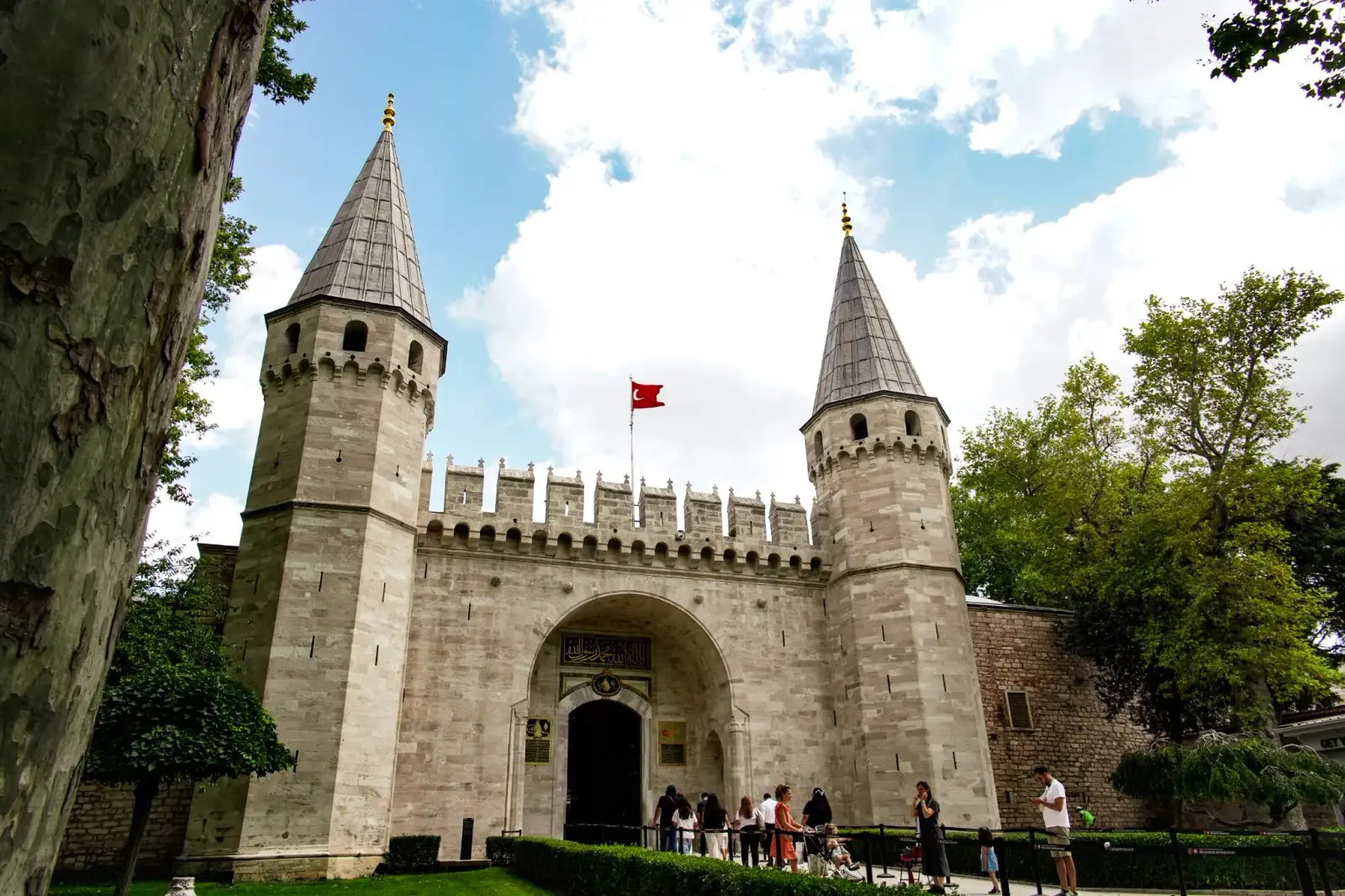
The second major gate, Bâbüsselâm also known as the Middle Gate, leads from the First Courtyard into the Second Courtyard the administrative heart of the palace. Its fortress-like appearance with flanking towers deliberately evokes strength and seriousness.
Here the symbolism becomes sharper. Only the reigning sultan and, in later periods the Valide Sultan was permitted to pass through this gate on horseback. Everyone else grand viziers, ambassadors, officials, and soldiers had to dismount and walk. This compulsory act of dismounting was not a minor protocol detail but it was a physical enactment of submission. The Gate of Salutation marked the true beginning of the sultan’s restricted realm. Crossing it meant leaving the semi-public world behind and entering the zone where the empire was governed.
The towers of the gate also contained holding cells for high officials who had fallen from favor, adding a further layer of meaning. The same threshold that granted access could also signify confinement and the precarious nature of power.
Bâbüssaâde – The Gate of Felicity (The Third Gate)
The most symbolically charged of the three principal gates is the Bâbüssaâde, the Gate of Felicity which opens into the Third Courtyard. This courtyard contained the palace school (Enderun) the Audience Chamber, the Imperial Treasury and the Privy Chamber that later housed the Sacred Relics. The Gate of Felicity represented the threshold of the innermost imperial domain. Beyond it lay the spaces most closely associated with the person of the sultan and the highest levels of court life. Ambassadors and high officials were received in the Audience Chamber just inside this gate but deeper penetration required special permission. The very name “Gate of Felicity” carried associations of blessedness and the auspicious presence of the ruler. In Ottoman political thought, proximity to the sultan was itself a form of good fortune and favor.
Ceremonies of accession, important audiences and the formal greeting of the sultan often centered on this gate. It stood as the architectural expression of the idea that the center of the empire was not merely a place of administration but a near-sacred space of legitimate sovereignty.
Taken together, the three main gates of Topkapı Palace formed a carefully graded system of thresholds. They translated abstract political hierarchy into physical experience. Each gate performed a dual function. It granted controlled access while simultaneously displaying the limits of that access. Architecture itself became a teacher of rank and order.
In the broader historical context of the fifteenth and sixteenth centuries when the palace took its classical form under Mehmed II and Süleyman the Magnificent, these gates helped construct the image of the Ottoman sultan as both the ultimate source of justice and a figure of carefully maintained seclusion. The ruler did not need to be constantly visible but the sequence of gates and the possibility of his unseen presence reinforced by features such as the Tower of Justice were enough to project authority.
Later centuries added decorative layers and occasional European stylistic touches yet the fundamental symbolic logic of the gates remained intact. They continued to stage the approach to power as a measured, hierarchical, and deeply meaningful journey. The gates of Topkapı Palace were among the most eloquent architectural statements of the Ottoman political order. Far more than functional entrances, they embodied the empire’s understanding of hierarchy, submission, justice and the carefully guarded distance between the sovereign and the world. To pass through them was to move, step by step closer to the center of an imperial system that made architecture itself an instrument of rule. Today they still stand as silent witnesses to a sophisticated culture of power in which every threshold carried meaning.
From Page to Palace
Reading about the history is only the beginning. Book your visit today and walk the same corridors as the Sultans.