
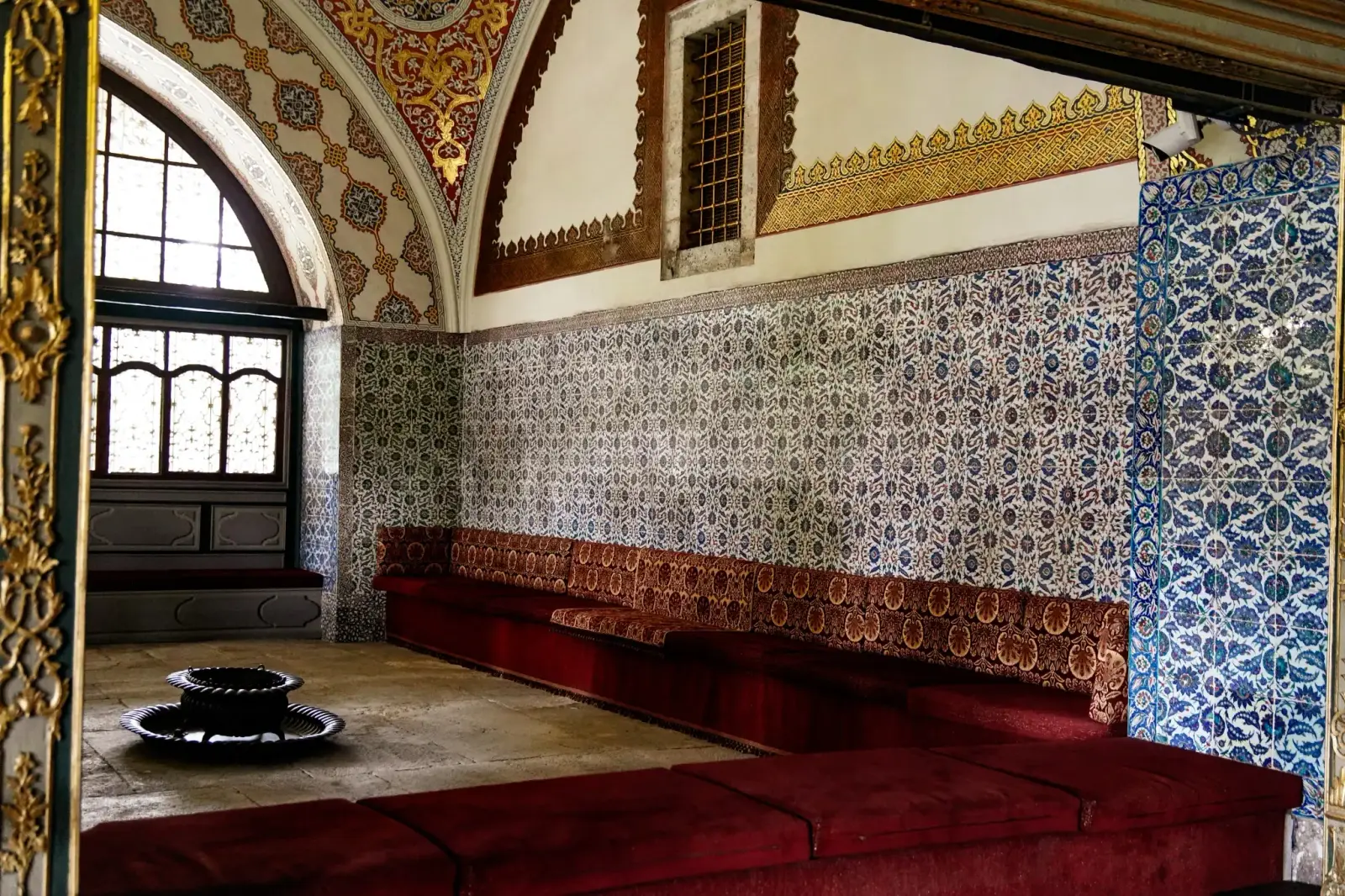
The Imperial Council (Divan-ı Hümayun) at Topkapı Palace
The empire’s cabinet and highest court, meeting under the Kubbealtı in the Second Courtyard — with the sultan listening from a grilled window above rather than sitting at the table.
The Divan-ı Hümayun was the central executive, administrative and judicial body of the Ottoman Empire for most of its classical period. It functioned as the de facto cabinet and highest council of state.
In the early Ottoman period the sultan often presided over councils in person. After the conquest of Constantinople in 1453 and the construction of Topkapı Palace from the 1460s onward, the system became more formalized. By the mid-15th century the council’s membership and procedures were regularized. Meetings were held in a dedicated building in the Second Courtyard known as the “Kubbealtı”.
The sultan himself rarely sat in the council after the early period. Instead, he could observe proceedings unseen through a latticed window the “Window of Justice” in the adjacent Tower of Justice, connected to his private quarters. This arrangement reinforced the image of the sultan as the ultimate source of authority while allowing the Grand Vizier to manage day-to-day government.
Meetings originally took place daily. By the 16th century they were usually held four days a week commonly including Tuesdays. In later centuries the frequency declined as power shifted toward the Grand Vizier’s own residence. The Divan remained symbolically and practically important at Topkapı for centuries until the 19th-century reforms reduced its role.
The core membership was relatively stable in the classical period:
Grand Vizier or Vezir-i Azam / Sadrazam: Presided over the council as the sultan’s absolute deputy. He directed overall policy, appointments, military command when the sultan did not lead a campaign and foreign affairs.
Kubbealtı Viziers: A small group of additional viziers typically three to seven who served as senior advisors. They ranked immediately after the Grand Vizier and provided experience on political and military matters.
Kazaskers (Military Judges): One for Rumelia (European provinces) and one for Anatolia. They were the highest judicial officials of the empire and represented Islamic law or “Şeriat” and legal administration.
Defterdars (Treasurers / Finance Ministers): Typically one or more often for Rumelia and Anatolia. They managed the imperial treasury, taxation and financial policy.
Nişancı (Chancellor): Responsible for drawing the sultan’s official monogram also known as “Tuğra” on documents, overseeing the chancery and maintaining records related to land grants (tımar system) and customary law (örf).
Additional high officials sometimes attended or held membership when they held vizier rank:
- The Kapudan Pasha (Grand Admiral of the fleet)
- The Chief or “Agha” of the Janissaries
- The Beylerbeyi of Rumelia when present in the capital
Supporting staff included the Reisülküttab who are chief clerk that had prepared the agenda and later evolved into a foreign-affairs role, scribes, translators, and ceremonial officers. The Şeyhülislam (Arch Cleric) wasn’t a formal member of the Divan although his legal opinions carried great weight.
The Divan’s remit was extremely broad. Virtually every major matter of state could come before it:
Political and administrative affairs such as;
- Appointments and dismissals of provincial governors, judges and high officials
- Reports from the provinces
- Internal security and public order
Military matters such as;
- Decisions on war and peace
- Organization of campaigns
- Fortifications and military logistics
Financial affairs;
- Taxation, budgets, and treasury management
- Land grants and fiscal records
Foreign relations;
- Reception of foreign ambassadors
- Negotiation and ratification of treaties
- Diplomatic correspondence
Judicial functions that Divan served as the empire’s highest court of appeal. Subjects of any religion or status could petition it against local judges, governors, or officials. It reviewed serious legal cases and issued final rulings in the sultan’s name.
Other business like;
- Public works and major construction projects
- Responses to petitions from ordinary subjects
- Ceremonial and protocol matters
Proceedings followed strict hierarchy and etiquette. The Grand Vizier opened and directed discussion. Matters were debated according to rank; decisions were recorded by scribes. Some decisions could be implemented immediately while others required formal submission to the sultan for approval. The Nişancı then authenticated the resulting imperial decrees with the monogram or “Tugra”.
The Imperial Council at Topkapı was the institutional heart of Ottoman governance. It combined executive decision-making, high justice, financial oversight, and diplomatic functions under one roof, all theoretically acting in the name of the sultan. Its location inside the palace, the possibility of the sultan’s unseen presence and the careful ranking of its members reflected the Ottoman ideal of ordered, hierarchical and just rule. Even as real power later shifted toward the Grand Vizier’s household and the Sublime Porte, the Kubbealtı remained the classic symbol of the empire’s central decision-making process.
From Page to Palace
Reading about the history is only the beginning. Book your visit today and walk the same corridors as the Sultans.