
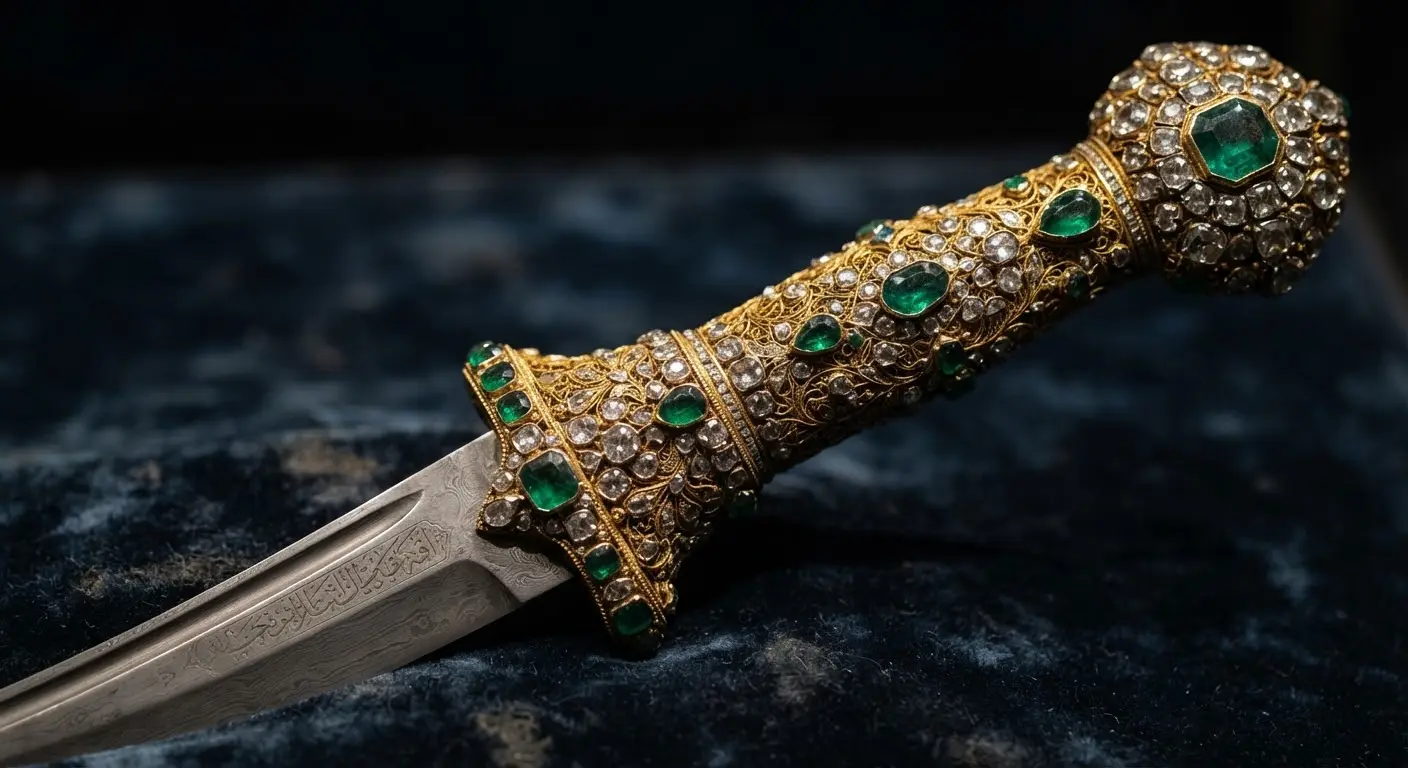
The Topkapı Dagger: The Story Behind the Palace’s Most Famous Treasure
A ceremonial jambiya made as a diplomatic gift for Nader Shah, three emeralds down its hilt and a watch hidden in its pommel — which never reached the man it was meant for.
The Topkapı Dagger is one of the most celebrated objects in the Imperial Treasury of Topkapı Palace. It is a highly ornate ceremonial dagger a curved jambiya-style weapon that was never intended for actual combat. Instead, it was created as a dazzling diplomatic gift and has become famous both for its extraordinary craftsmanship and for the dramatic historical circumstances that kept it in Istanbul.
History
In the mid-18th century the Ottoman Empire and Persia under the Afsharid dynasty had just emerged from conflict. The Ottoman–Persian War of 1743–1746 ended with the Treaty of Kerden on 1746. Both sides sought to stabilize relations through the traditional exchange of lavish gifts that a common practice among early modern Islamic courts to display wealth, prestige and goodwill.
Sultan Mahmud I (r. 1730–1754) commissioned the dagger around 1746–1747 as part of a large diplomatic present for Nadir Shah of Persia (r. 1736–1747) one of the most powerful and ambitious rulers of the age sometimes called the “Napoleon of Persia”. Nadir Shah had recently sacked Delhi and acquired enormous Mughal treasures including many fine emeralds. The Ottoman gift was meant to match that level of magnificence and reinforce the newly established peace.
An Ottoman embassy led by Ahmed Pasha (Kesriyeli) accompanied by a large retinue, set out to deliver the gifts. While the mission was still en route, news arrived that Nadir Shah had been assassinated by his own officers on 20 June 1747. Fearing chaos and the possible loss of the treasures, the ambassadors turned back and returned everything to Istanbul. The dagger therefore never reached its intended recipient and entered the Ottoman Imperial Treasury instead.
Interestingly, Nadir Shah had already sent his own gifts to Mahmud I including jewels, a Mughal throne, and elephants. Those did arrive, making the exchange one-sided from the Ottoman perspective.
Description and Craftsmanship
The dagger is a masterpiece of 18th-century Ottoman goldsmithing and gem-setting:
The hilt is set with three large, high-quality emeralds roughly walnut-sized which dominate its appearance.
A fourth emerald on the pommel conceals a small working watch, an English-made mechanism, sophisticated and unexpected mechanical feature.
The scabbard is richly decorated with diamonds and enamel floral motifs the reverse side is especially finely worked and often overlooked by visitors.
The overall design combines Ottoman, Persianate and European elements, reflecting the cosmopolitan taste of the imperial workshops.
Importance
Diplomatic Symbol: It perfectly illustrates the role of luxury objects in Ottoman foreign relations. Gifts of this quality were political statements as much as personal presents.
Artistic Masterpiece: It ranks among the finest surviving examples of Ottoman jeweled weaponry and demonstrates the technical skill of the palace workshops.
Historical Irony: Its fame is inseparable from the fact that it never fulfilled its original purpose. The assassination of Nadir Shah turned a peace offering into a permanent Ottoman treasure.
Modern Cultural Icon: The dagger became globally known through Jules Dassin’s 1964 heist comedy film “Topkapı”, in which it is the object of an elaborate theft. The movie made the real dagger one of the most recognized artifacts in the palace.
Today the Topkapı Dagger remains on permanent display in the Imperial Treasury at Third Courtyard. Along with the Spoonmaker’s Diamond, it is one of the two objects that almost every visitor specifically seeks out. It stands as a vivid reminder of 18th-century diplomacy, the extraordinary wealth of the Ottoman court, and the unpredictable twists of history that sometimes leave the most spectacular gifts unopened.
From Page to Palace
Reading about the history is only the beginning. Book your visit today and walk the same corridors as the Sultans.