
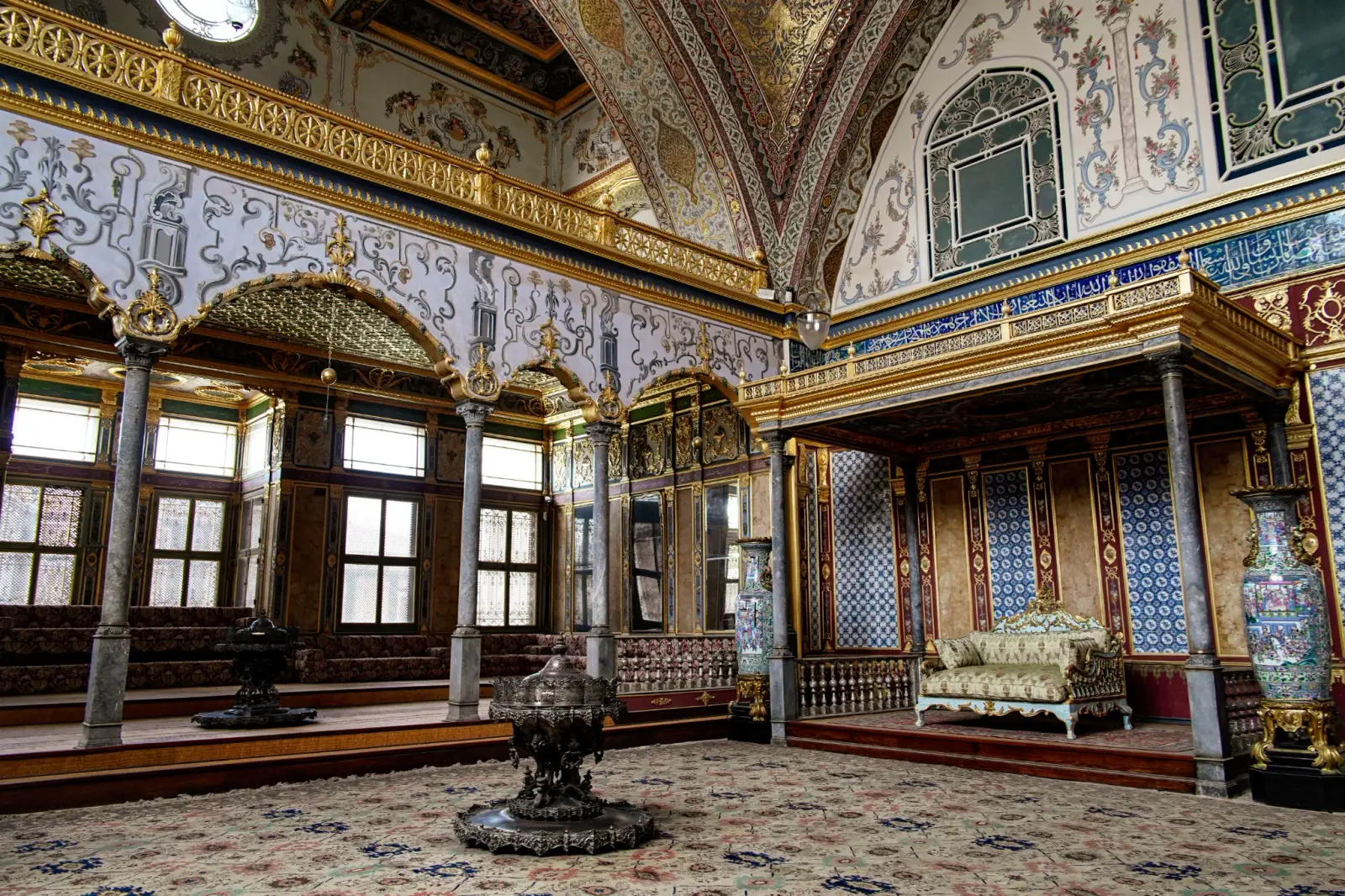
Topkapi Palace in the Age of Suleiman the Magnificent
Under Süleyman I the restrained New Palace became the ceremonial centre of a world empire — larger audience halls, a rebuilt treasury and a court culture to match the reach.
Süleyman I’s long reign marked the decisive transformation of Topkapı Palace from the relatively restrained New Palace founded by Mehmed II the Conqueror into the fully developed imperial residence and administrative center of a world empire at its peak. While the basic four-courtyard layout established by the Conqueror was preserved, the palace was significantly expanded, enriched and functionally redefined to match the power, wealth and evolving court culture of the age.
By the time Süleyman came to the throne, the Ottoman Empire was expanding rapidly across three continents. The sultan wanted his residence to express this new scale of power. Ceremonial spaces were rebuilt on a larger and more impressive scale, infrastructure was strengthened to support a growing bureaucracy and household and the overall complex was enlarged. The palace became both the administrative heart of the empire and a more complete family residence.
The chief architect associated with much of this work was the Persian master known as Alaüddin also known as Acem Ali. Under his direction and that of other court architects, important ceremonial and residential buildings were improved or reconstructed.
The single most important change during Süleyman’s reign was the permanent relocation of the Imperial Harem into Topkapı Palace. Until that period, the women of the dynasty had largely remained in the Old Palace in the Beyazıt area, in accordance with earlier custom established by Mehmed II who preferred to keep the residential harem separate from the seat of government. Hürrem Sultan (Roxelana), Süleyman’s powerful favorite and later legal wife played a central role in breaking this tradition. After a fire damaged the Old Palace in 1541 and through her influence, the harem was transferred to Topkapı.
This move fundamentally altered the character of the palace.Topkapı was no longer primarily a male administrative and educational complex with a limited private zone. It became a full imperial household. The Harem began its long process of expansion, eventually growing into a large, multi-courtyard quarter with hundreds of rooms. The presence of the sultan’s family at the political center also increased the influence of the Haseki and later, the Valide Sultans laying the groundwork for the period later known as the Sultanate of Women.
During Süleyman’s reign several key areas of the palace were shaped or strengthened:
Ceremonial and audience spaces were enlarged or refined to accommodate the more elaborate protocol of a great empire.
The Middle Gate (Bâbüsselâm) received important work, including its massive gilded iron doors around 1525.
Service and support infrastructures like kitchens, storage and related facilities were expanded to feed and maintain a much larger palace population.
Early permanent structures for the Harem were constructed. It started the organic and additive growth that would continue for generations.
Decorative enrichment increased with finer tilework, marble and interior finishes reflecting the prosperity of the era.
The palace at this time housed a large and complex community including pages of the Enderun school, officials, eunuchs, the growing harem and service staff that was estimated in the thousands.
Süleyman’s reign gave Topkapı the essential form and character it would retain for the rest of the classical period. The combination of preserved hierarchical layout, expanded ceremonial spaces and the permanent integration of the Harem created the mature palace that later sultans would continue to modify but not fundamentally reinvent. By the end of his rule, Topkapı stood as the architectural embodiment of an empire at the height of its power. It was ordered, hierarchical, increasingly family-centered and capable of projecting both political authority and dynastic continuity.
In short, Süleyman did not invent Topkapı Palace, but he transformed it into the full imperial residence of the Ottoman golden age. The changes made under his patronage especially the arrival of the Harem shaped the palace’s identity for centuries to come.
From Page to Palace
Reading about the history is only the beginning. Book your visit today and walk the same corridors as the Sultans.