
The Spoonmaker’s Diamond (Kaşıkçı Elması)
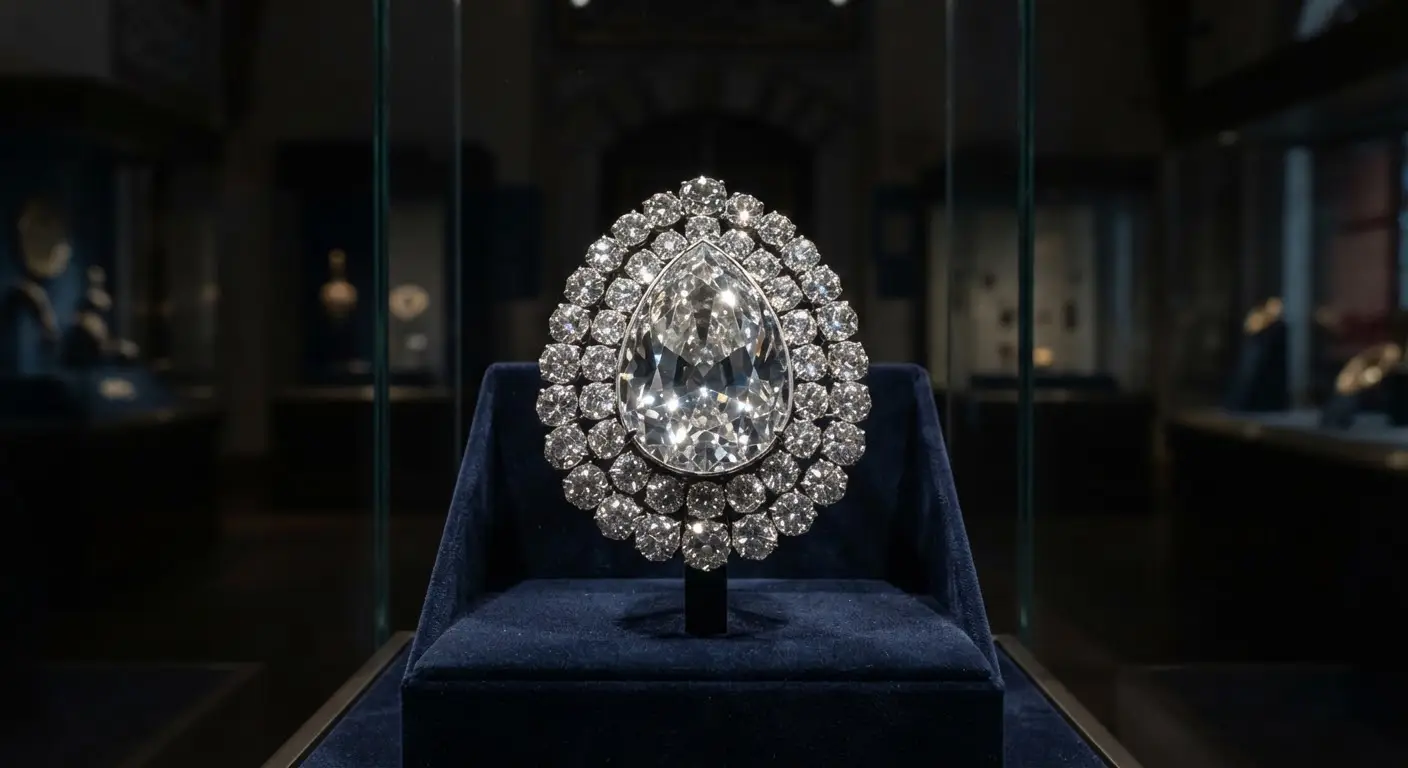
Eighty-six carats, pear-cut, set in silver inside a double row of forty-nine smaller stones — one of the largest diamonds on public display anywhere in the world.
The Spoonmaker’s Diamond is one of the most famous treasures in the Imperial Treasury of Topkapı Palace. It is an 86-carat pear-shaped diamond mounted in silver and surrounded by a double row of 49 smaller diamonds. Its brilliance and size make it one of the largest and most striking diamonds on public display anywhere in the world. It is displayed in its own specially lit case in the Treasury section of the Third Courtyard.
Physical Description
Weight: approximately 86 carats
Shape: pear or waterdrop shape
Setting: Silver mount with 49 surrounding brilliant-cut diamonds arranged in two rows
Appearance: the large central stone is said to look like “a full moon lighting a bright sky among the stars” because of the smaller diamonds around it
Historical Context
Unlike many other major diamonds such as the Koh-i-Noor or the Hope Diamond, the Spoonmaker’s Diamond has no securely documented early ownership history. Palace records mention a large diamond already present in the Ottoman treasury by the time of Sultan Mehmed IV (r. 1648–1687). The present setting with the surrounding smaller diamonds is generally attributed to the early 19th century, most likely during the reign of Sultan Mahmud II (r. 1808–1839).
How the diamond originally entered Ottoman possession remains uncertain. Historians agree that the popular folk stories are almost certainly legendary rather than factual and that the stone’s true path into the treasury is still a mystery.
The Legend and Mystery
The diamond’s fame rests largely on the colorful legends that grew up around it. The most widely told story runs roughly as follows:
In the mid- or late 17th century, a poor man was walking near the Eğrikapı district of Istanbul. Among the refuse on the shore or in a rubbish heap he found a large, unusually shiny stone. Not realizing its value, he carried it around for a while and eventually offered it to a spoonmaker in exchange for three wooden spoons.
The spoonmaker, suspecting the stone might be worth something, took it to a jeweler. The jeweler recognized it as a diamond of extraordinary size and quality. Word of the find eventually reached the palace. The diamond was acquired for the imperial treasury, cut and reshaped into its present pear shape, and given the name “Spoonmaker’s Diamond” after the humble craftsman who first received it.
Variations of the tale exist: in some versions the finder is a garbage collector; in others the spoonmaker himself becomes the central figure and in still others the diamond passes through several jewelers before the palace takes possession.
A second, later legend links the stone to Europe and India. According to this version, a French officer named Pigot acquired a large diamond in India in the 1770s. It later appeared at auction in Paris, was briefly associated with Napoleon’s mother Letizia Ramolino, and was eventually purchased by an agent of the powerful Albanian Ottoman governor Tepedelenli Ali Pasha. After Ali Pasha’s execution in 1822, his property including the diamond was confiscated by the central government and entered the imperial treasury.
Modern research has cast doubt on both stories. The weight of the known Pigot Diamond does not match the Spoonmaker’s Diamond, and no contemporary Ottoman document has been found that definitively traces the stone’s arrival. The name “Kaşıkçı” or Spoonmaker itself may simply refer to the pear shape of the cut stone, which resembles the bowl of a spoon, rather than to any actual spoonmaker.
Importance
The Spoonmaker’s Diamond is important for several reasons:
It is one of the largest diamonds on permanent public exhibition.
It represents the mystery and romance that often surround great gems. Ordinary people finding extraordinary fortune, the sudden transfer of wealth from the street to the palace and the enduring power of legend.
Together with the Topkapı Dagger, it is the object most visitors specifically seek out in the Imperial Treasury.
It illustrates how oral tradition and folklore can become more famous than the sparse documentary record.
In short, the Spoonmaker’s Diamond remains both a spectacular physical treasure and an unsolved historical puzzle. Its true origin may never be known with certainty which only adds to its allure. The stone sits in Topkapı Palace today as a brilliant reminder that some of the greatest treasures carry stories that are as captivating as the gems themselves.
From Page to Palace
Reading about the history is only the beginning. Book your visit today and walk the same corridors as the Sultans.