
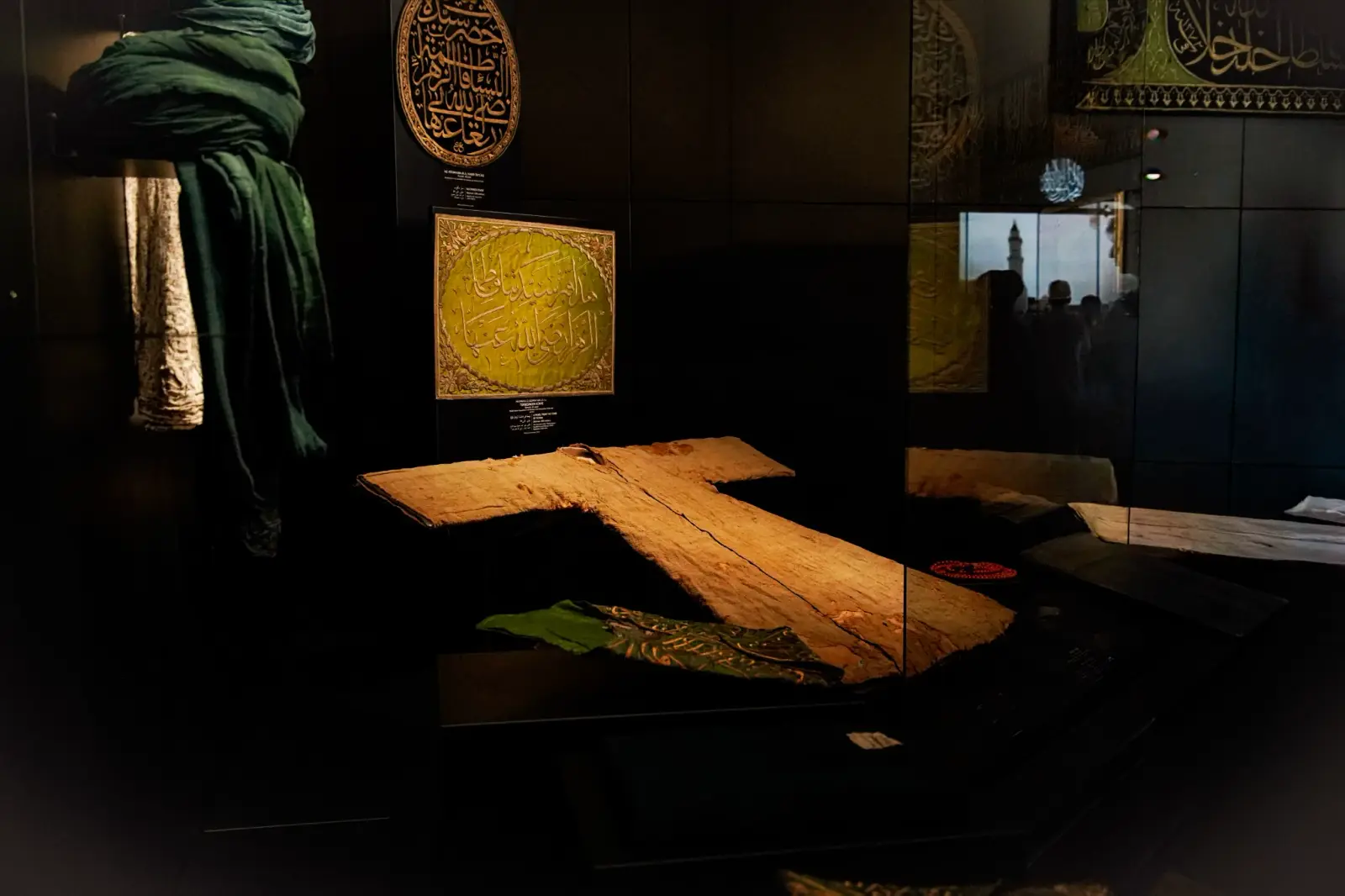
The Sacred Relics of Topkapı Palace
The Holy Mantle, the Prophet’s footprint, the swords of the companions: how the objects Selim I brought back from Egypt underwrote the Ottoman claim to the Caliphate.
These are among the most revered objects in the Islamic world. They are kept in the Chamber of the Holy Mantle (Hırka-i Saadet Dairesi / Privy Chamber / Has Oda) in the Third Courtyard of Topkapı Palace. The chamber was originally the sultan’s private apartments and was later dedicated almost entirely to the relics.
1. Historical Importance
The relics served as powerful symbols of the Ottoman sultans’ claim to the Caliphate the spiritual leadership of the Sunni Muslim world after 1517. Guarding them was considered one of the sultan’s highest religious duties. They legitimized Ottoman authority over the holy cities of Mecca, Medina and Jerusalem and reinforced the idea of the sultan as the “Shadow of God on Earth.”
The chamber was treated as a living shrine rather than a static museum. A continuous, unbroken recitation of the Quran has taken place there 24 hours a day since the 16th century one full reading completion every day. The tradition began when Sultan Selim I reportedly said, “Find me 39 hafizes; I will be the 40th.” It continues today with rotating teams of memorizers.
Annual Ramadan ceremonies involved the sultan personally visiting the chamber and the dust swept from the room was considered so sacred that it was poured into a special well rather than discarded.
2. Acquisition
The core collection arrived in 1517 after Sultan Selim I the Grim conquered Mamluk Egypt and the Hejaz. The last Abbasid caliph in Cairo named al-Mutawakkil III transferred the caliphate and several major relics especially the Holy Mantle to Selim. Additional items came from Mecca and Medina.
Over the following centuries more relics were added through gifts, purchases and protective transfers. In the late 18th and 19th centuries, objects were moved to Istanbul for safekeeping from Wahhabi attacks. During World War I, Fahreddin Pasha, the defender of Medina sent further relics to Istanbul to prevent them from falling into British hands. The total registered collection now numbers around 600 items. Some displayed while others in storage or other museum sections.
3. Preservation Throughout History
These relics were initially kept in the Imperial Treasury or harem areas. Later concentrated in the Privy Chamber under special officials named Hasodalılar who cleaned, guarded, and burned incense. The sultan himself held the keys to the most important chests and it was under his personal protection of those relics’ secrecy.
During World War I the relics were temporarily moved to Konya for safety; during World War II some were sent to Niğde. After the abolition of the Caliphate in 1924 and the conversion of Topkapı into a museum, the Turkish Republic continued careful conservation. Recent restorations including the one at 2023, have improved display conditions while maintaining the continuous Quran recitation and an atmosphere of reverence. Photography is restricted in the inner chamber.
4. Major Relics
The Holy Mantle (Hırka-i Saadet / Blessed Mantle): The single most important relic. According to tradition, the Prophet Muhammad gave this cloak to the poet Kaʿb ibn Zuhayr after the poet recited a famous ode upon converting to Islam. It was later held by Abbasid caliphs, moved to Egypt and given to Selim I in 1517. It is preserved in nested gold chests, wrapped in multiple layers of fabric, and opened only for special ceremonies traditionally on the 15th of Ramadan.
Hairs from the Prophet’s Beard (Sakal-ı Şerif / Lihye-i Saadet): Strands of hair attributed to the Prophet’s beard. Kept in small glass or jeweled reliquaries. These were among the items brought or added after the Egyptian campaign and later transfers.
The Prophet’s Footprint (Kadem-i Şerif / Naqsh-ı Kadem-i Saadet): Stone or brick impressions believed to be the Prophet’s footprints. Displayed in ornate frames or cases.
The Prophet’s Tooth (Dendan-ı Saadet): A fragment of the tooth broken during the Battle of Uhud in 625 CE. Housed in a jeweled reliquary that one version associated with the last Ottoman sultan, Mehmed VI.
Letters of the Prophet (Name-ı Saadet): Original or early copies of letters the Prophet sent to rulers (including the Governor of Egypt, the Ghassanid king, and others). These are among the rarest documentary relics.
Swords of the Prophet and the Companions or “Sahabes” (Süyûf-ı Mübareke): Approximately 20 swords. Two are attributed to the Prophet himself while others belong to the Rightly Guided Caliphs Abu Bakr, Umar, Uthman, Ali and famous Companions such as Khalid ibn al-Walid. Handles and scabbards were often later Ottoman work.
The Staff of Moses (Asâ-yı Musa): A wooden staff traditionally identified as the rod of the Prophet Moses. It is one of the older prophetic relics in the collection.
Keys, Locks, and Architectural Elements of the Kaaba: Keys and locks of the Kaaba, casings of the Black Stone (Hacerü’l-Esved), rain gutters and parts of doors including the Door of Repentance. These symbolize Ottoman custodianship of the holiest site in Islam.
5. Other Notable Items
- The Holy Banner (Sancak-ı Şerif) used in Ottoman campaigns.
- Bow of the Prophet.
- Relics associated with earlier prophets suchj as Abraham’s cooking vessel or tray, Joseph’s robe or turban and David’s sword.
- Items linked to Fatimah the Prophet’s daughter and other early figures.
- Soil from the Prophet’s tomb, covers from sacred graves, and various personal objects like sandals, water vessel, etc.
The Sacred Relics remain one of the most spiritually significant collections in the Islamic world. Their presence transformed part of the sultan’s private apartments into a continuous place of devotion, linking the political power of the Ottoman Empire to the earliest history of Islam for more than five centuries.
From Page to Palace
Reading about the history is only the beginning. Book your visit today and walk the same corridors as the Sultans.